
One of the first questions brands ask when planning temporary retail is: how much does a pop-up shop cost in London?
There is no single answer. A compact showroom, a Shoreditch storefront and a highly visible Soho unit can require completely different budgets.
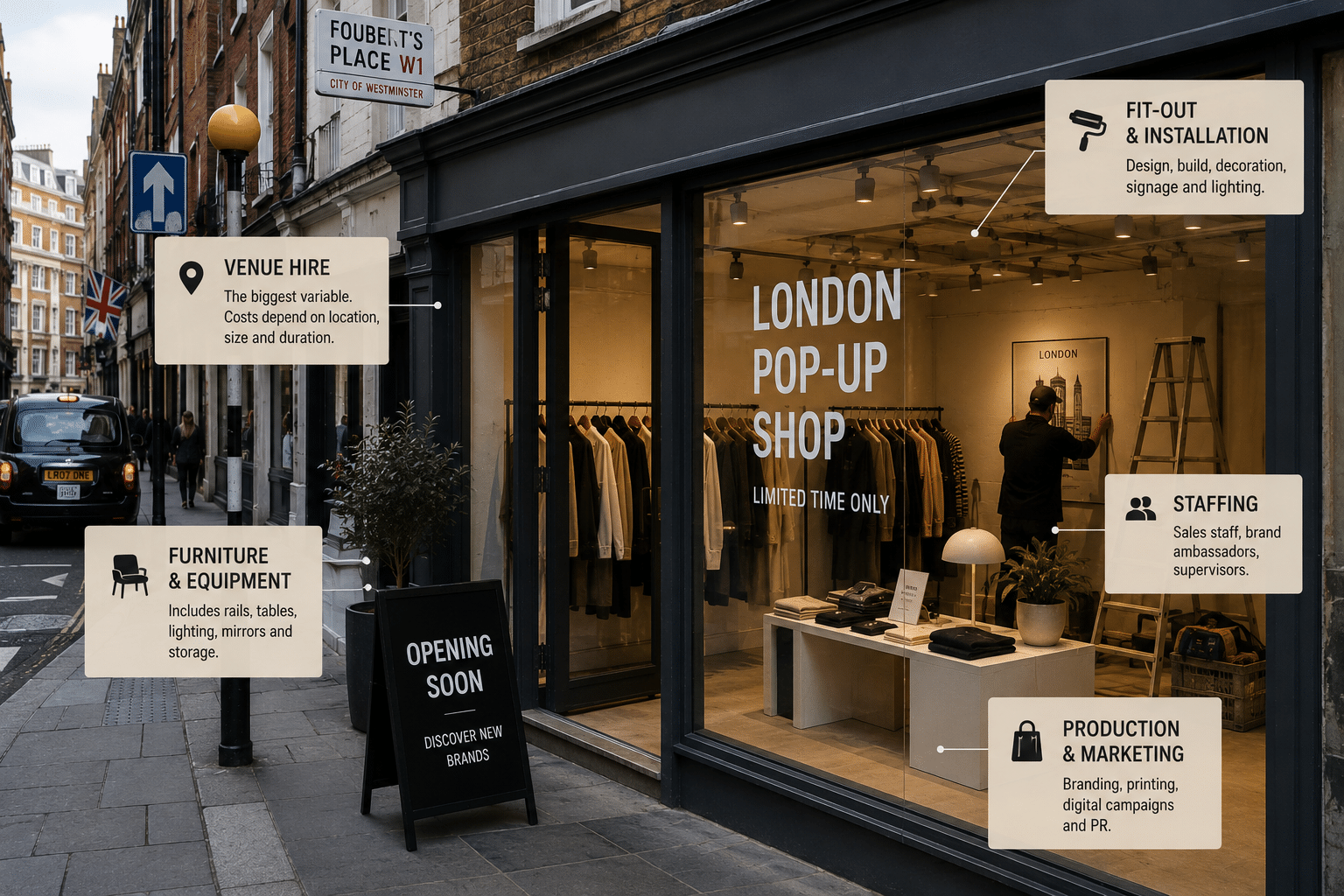
Venue hire is also only the beginning. Design, furniture, branding, production, staffing, logistics, insurance, technology, permits, installation and dismantling can all contribute to the final investment.
The more useful question is: what will it cost to create the pop-up this brand actually needs?
How much does it cost to rent a pop-up space in London?
There is no standard daily rate. The price depends on the neighbourhood, exact street, size, footfall, storefront, duration, dates, existing fit-out, facilities, technical requirements and permitted use.
Two spaces of a similar size can therefore have very different rates.
A highly visible central retail unit may command a premium over a studio or showroom where visitors arrive by appointment. That does not automatically make the central unit better. Its value depends on what the activation needs to achieve.
You can compare available pop-up spaces in London for the required dates and then calculate the total cost of opening each option.
Why prices vary so much
1. Neighbourhood and micro-location
London contains multiple retail environments.
Soho may prioritise centrality, visibility and proximity to major shopping and entertainment areas. Shoreditch may offer a stronger fit for creative positioning, independent retail and streetwear. Covent Garden can provide a more established West End shopping context.
The right question is not “Which neighbourhood is cheapest?”, but which location gives the activation the right audience and commercial context?
2. Size and layout
Larger venues generally cost more to rent and create additional costs for furniture, lighting, branding, staffing, cleaning and production.
If the concept works in 60 square metres, moving into a 200-square-metre venue can weaken the budget across the entire project.
3. Footfall
A busy retail street can generate organic discovery, but not all footfall is equally valuable.
Ten thousand passers-by offer limited value when few match the target audience. Compare both the volume and quality of traffic.
4. Storefront
Large windows, corner positions and prominent entrances can increase the rate.
For a sales-led pop-up, the façade acts as a physical advertising asset. For a private showroom, paying extra for frontage may not be necessary.
5. Duration
The total cost rises with time, but the daily rate is not always linear. Longer bookings may allow different commercial terms.
6. Dates
Fashion, design, cultural and commercial moments can increase demand for strong temporary spaces.
Brands with fixed dates should start the venue search early.
7. Existing fit-out
A lower-priced empty venue may become more expensive after furniture hire, lighting, production and installation.
A higher-priced space with an existing retail fit-out may be more cost-efficient overall.
Venue hire is only part of the budget
The complete budget can include:
venue + design + production + operations + logistics + marketing.
A simple showroom and an immersive brand experience may rent spaces at similar rates but require radically different total investments.
Main cost categories
Venue hire
Confirm what the rate includes and whether utilities, furniture, storage, cleaning or service charges are additional.
Design and adaptation
A simple project may require light visual changes. A larger activation may need spatial design, technical drawings, custom furniture, carpentry, lighting and temporary structures.
Furniture
Rails, tables, counters, shelving, mirrors, seating and displays must be included, hired or produced.
Branding
Window graphics, signage, vinyl, interior graphics, wayfinding and branded installations all affect the budget.
Production, installation and dismantling
Everything designed must be fabricated, delivered, installed and later removed.
Staffing
Retail staff, brand ambassadors, hosts, security and on-site management may be required.
Logistics
Transport, deliveries, stock handling, storage, replenishment, collection and waste removal need to be planned, especially in central London.
POS and technology
Payment systems, devices, connectivity, screens, sound and specialist lighting may form part of the operation.
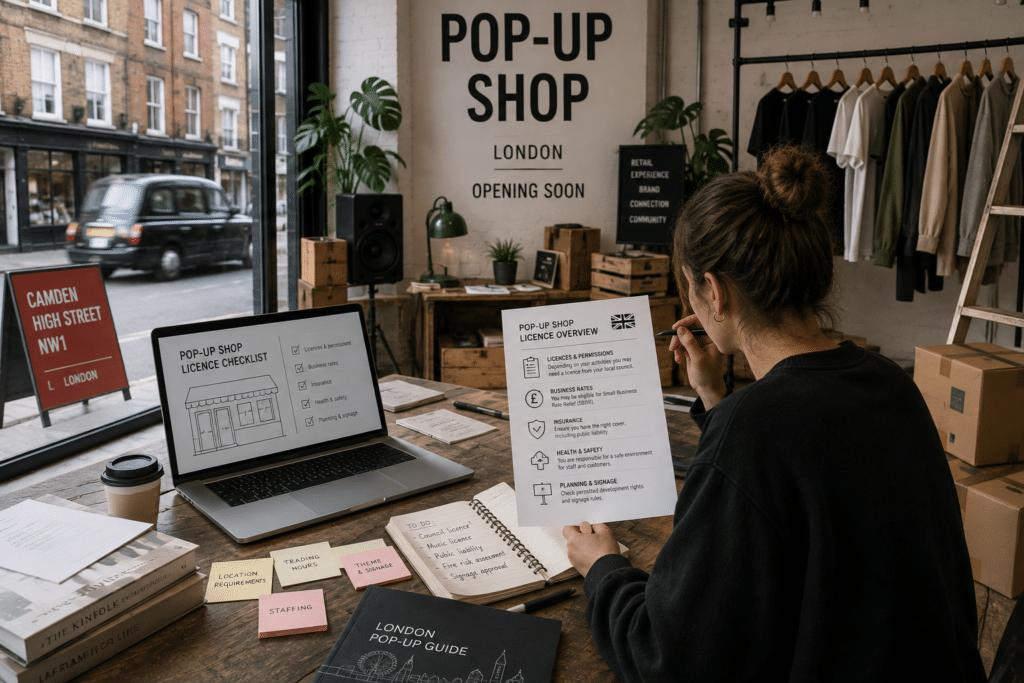
Licences, permissions and insurance
Food, alcohol, music, entertainment and certain events may require additional permissions.
The guide to UK pop-up shop licensing and regulations explains the main areas to review.
Three budget models
1. Lean market test
A DTC brand uses a small or medium-sized venue, existing furniture, light branding, a small team and a short duration.
The priority is learning how customers respond offline rather than creating a temporary flagship.
2. Branded retail pop-up
A fashion, beauty or lifestyle brand may need a strong location, visible storefront, custom identity, furniture, staff, POS, stock logistics and installation.
3. Premium brand activation
An international launch may require a premium location, bespoke scouting, creative concept, custom production, technical installations, audiovisual equipment, staffing, security, logistics and local project management.
How to build a realistic budget
- Space: venue rental and costs associated with securing it.
- Design and production: concept, furniture, branding, fabrication, technology and installation.
- Operations: staff, security, POS, cleaning and daily management.
- Logistics: transport, stock, storage, replenishment and dismantling.
- Marketing: content, media, PR, creators and traffic generation.
This structure avoids spending too much on the venue and leaving too little to activate it properly.
How to reduce costs without losing impact
- Choose a venue that requires less adaptation.
- Avoid unnecessary square metres.
- Reuse furniture and equipment already available.
- Keep the concept focused.
- Remain flexible on the micro-location.
- Plan early.
How long should a London pop-up run?
One or two days may work for product launches, press events, creator events and limited drops.
A week or several weeks is more useful for retail testing, customer acquisition, awareness and analysis of normal shopping behaviour.
Do not automatically choose the shortest duration. If the activation closes before it answers the business question, the lower cost may represent weaker value.
How to choose the right London neighbourhood
Different districts serve different strategies:
- Soho for centrality, visibility and culture.
- Shoreditch for independent retail, streetwear and creative positioning.
- Covent Garden for an established West End shopping environment.
The neighbourhood should follow the audience and objective, not reputation alone.
From venue search to execution
For a straightforward activation, a ready-to-use venue may be enough. More ambitious projects require design, adaptation, local suppliers, staffing, permits, logistics and on-site coordination.
Brands without a UK team can develop the brief with the Go—PopUp agency.
How much does a London pop-up cost? Key takeaway
There is no single figure.
The total cost depends on:
neighbourhood + micro-location + venue + duration + fit-out + production + operations.
The cheapest available venue is not automatically the most cost-efficient choice. Start with the objective and compare the full cost of making each option operational.