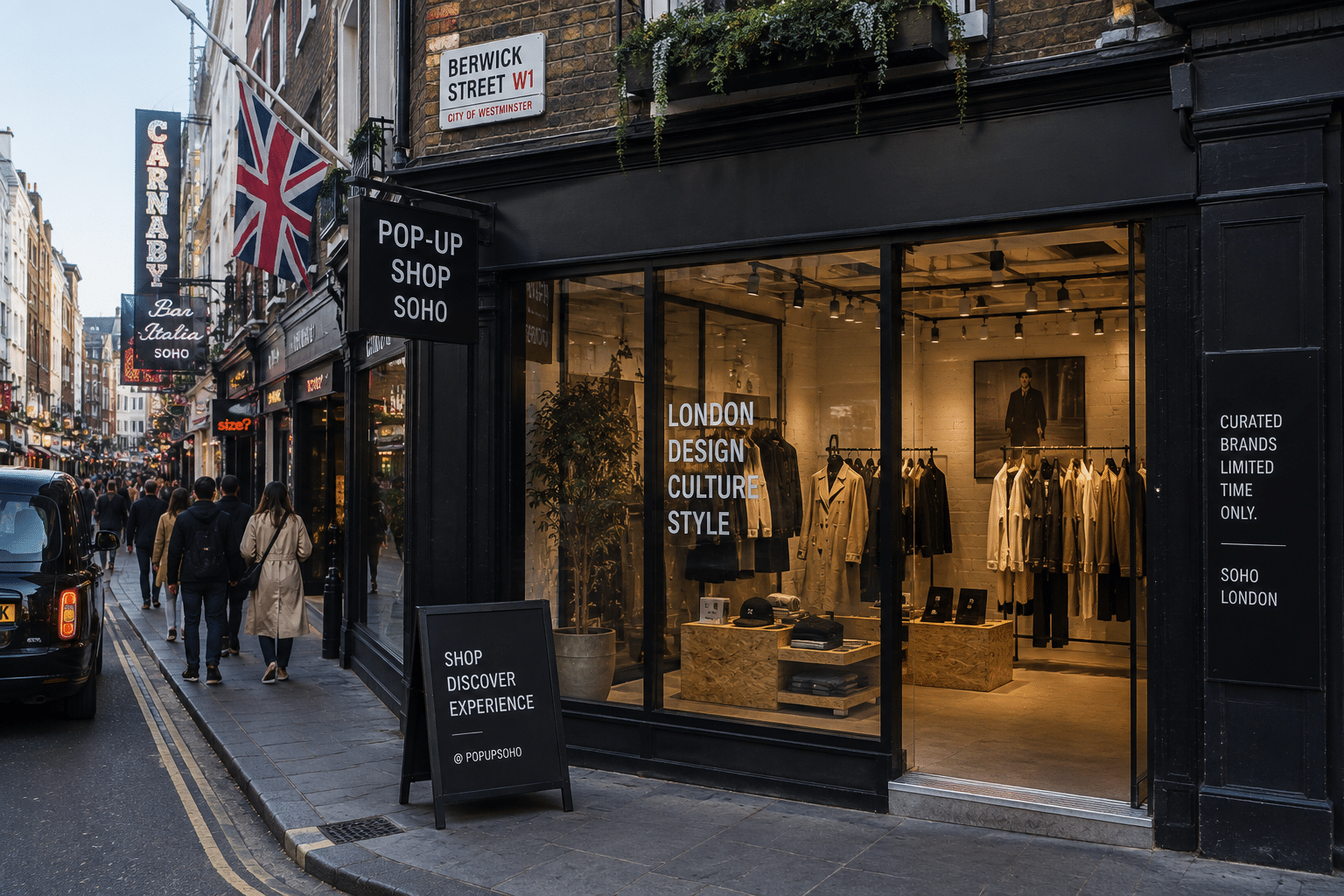

Few London neighbourhoods offer brands the combination of visibility, centrality and cultural relevance that Soho does.
Fashion, beauty, hospitality, nightlife, media and entertainment overlap within a compact network of streets. That makes the area attractive for temporary retail, but it also means that the exact micro-location matters.
A venue close to Carnaby Street serves a different purpose from one near Oxford Street or deeper inside Soho. Footfall, audience, neighbouring businesses, visibility and the activation format all need to align.
Why Soho works for pop-up shops
Soho combines high commercial visibility with an identity shaped by fashion, music, hospitality and independent businesses.
It can be particularly relevant for:
- Fashion and accessories.
- Beauty and cosmetics.
- Premium lifestyle brands.
- Product launches and limited drops.
- DTC brands entering physical retail.
- Experiential activations.
- Press and creator events.
- International brands testing London.
The value is not limited to sales. A well-positioned pop-up can generate awareness, customer interaction, content and market insight at the same time.
The main Soho areas to compare
Carnaby and the surrounding streets
Carnaby is one of Soho’s most recognisable retail destinations and has strong links with fashion, lifestyle and independent concepts.
It can suit fashion, footwear, accessories, beauty, collaborations and consumer-facing launches.
Neighbouring brands and storefront visibility are especially important. The external treatment of the venue should be evaluated as part of the campaign.
The Oxford Street side: scale and exposure
Towards Oxford Street, the commercial environment becomes more focused on volume and visibility.
This may work for major consumer launches, beauty, fashion, technology and highly visual activations.
More traffic does not automatically mean better performance. The people passing the venue still need to match the target audience.
Berwick Street and central Soho: independent character
Berwick Street and the inner streets combine retail, food, music and independent businesses.
They can suit independent fashion, music-led concepts, creative brands, lifestyle, food activations and community projects.
For these brands, a less obvious location can provide a stronger cultural context than the busiest available unit.
Dean Street and the Soho interior: events and experiences
Soho’s hospitality and entertainment identity also supports projects that combine retail with events, content and community.
Private presentations, creator events, workshops, showrooms and launch parties may prioritise atmosphere, capacity and technical flexibility over constant footfall.
What type of Soho space should you choose?
Traditional retail unit
Best when direct sales and walk-in traffic are the priorities. Look for strong frontage, storage, product-display space, fitting rooms and a clear customer journey.
Showroom
Useful for press, buyers, creators, VIP customers and appointments. Interior quality and privacy can matter more than a premium storefront.
Experiential venue
Appropriate for immersive installations, demonstrations, talks, workshops, exhibitions and launch events.
Small-format retail
A compact venue can create urgency and keep production manageable for limited collections, collaborations and product drops.
What to check before booking
1. Footfall quality
Soho attracts tourists, professionals, shoppers, hospitality customers and West End visitors. The question is not only how many people pass, but who they are.
2. Street visibility
Review storefront, window size, signage, entrance visibility and sightlines.
3. Neighbouring businesses
For fashion, beauty and lifestyle brands, the commercial ecosystem helps position the pop-up.
4. Internal layout
Plan product display, staff areas, storage, queues, fitting rooms and any event or content zone.
5. Technical infrastructure
Confirm power, internet, lighting, heating, toilets, sound, audiovisual requirements and security.
6. Branding permissions
Clarify what can be changed across windows, walls, signage, lighting, furniture and exterior elements.
7. Logistics
Central London can complicate deliveries, supplier access, installation and waste collection. Plan these early.
8. Permitted use
Food, alcohol, music, entertainment and certain events may need additional permissions.
The guide to UK pop-up shop licensing and regulations covers the main questions.
How much does a Soho pop-up cost?
There is no standard price. The cost depends on the exact street, size, footfall, frontage, duration, dates, fit-out, included equipment and production required.
The complete budget may also include design, furniture, branding, transport, staffing, insurance, permits, POS, audiovisual equipment, installation, cleaning and dismantling.
For a broader framework, see the guide to London pop-up shop costs.
How long should a Soho pop-up last?
One or two days can work for press, creators, launches and private events.
A week provides more time for organic discovery, content and sales. Several weeks may be more useful for testing London or building sustained local awareness.
If market testing is the objective, a very short activation may generate excitement without producing representative customer data.
When should you launch?
Weekends can provide strong leisure and shopping traffic. Weekdays may work better for professional, press or industry audiences.
Fashion, art, music and cultural moments can increase relevance but also create more competition for venues and suppliers.
How to book a Soho pop-up
- Define the objective: sales, launch, London entry, market testing, press, content or experience.
- Prepare the venue brief: dates, duration, budget, audience, area, technical needs, storage and branding.
- Explore spaces: compare pop-up spaces in London.
- Compare strategically: audience, footfall, neighbours, visibility, layout and production implications.
- Plan execution: design, suppliers, staffing, logistics, POS, permits and on-site management.
For a more creative East London context, compare the Shoreditch pop-up guide. For a more established West End retail environment, see the Covent Garden guide.
Beyond the venue
Finding a location is only the beginning. Go—PopUp combines marketplace access with personalised scouting and project support.
International brands without a UK team can coordinate concept, adaptation, production, suppliers, staffing, logistics and project management with the Go—PopUp agency.
Is Soho right for your next pop-up?
Soho offers high commercial visibility within a neighbourhood that still has a strong cultural identity.
The decision should not be based only on the fame of the postcode. It must align brand + audience + micro-location + venue + format + timing.