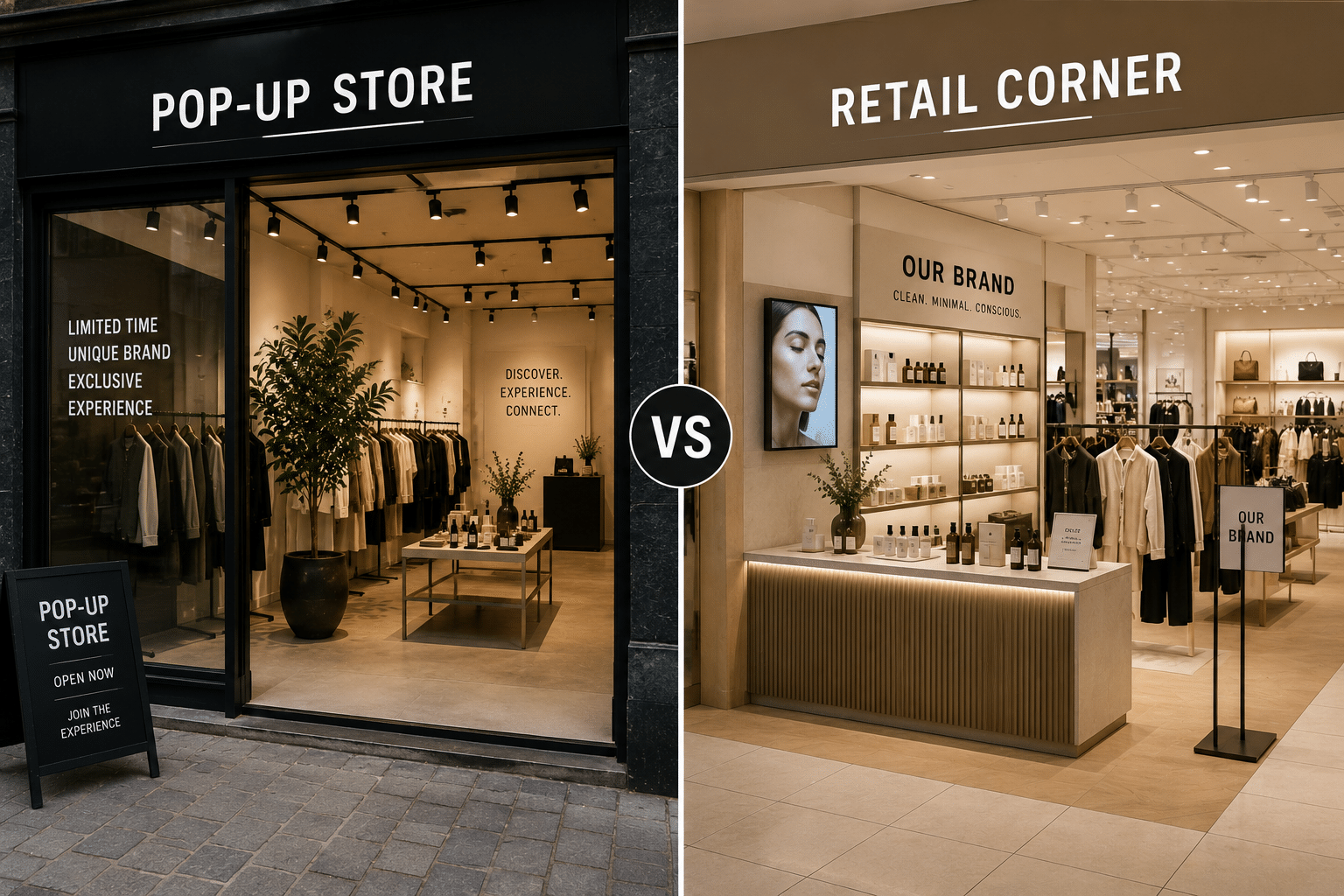

Pop-up store, temporary shop, retail corner, shop-in-shop and temporary showroom are all ways for a brand to enter physical retail without immediately opening a permanent store.
They are often used as if they were interchangeable, but they do not describe the same model. The choice affects brand control, investment, footfall, customer experience, operations and the type of market insight the project can generate.
This guide explains the differences between a pop-up store, temporary shop and retail corner and when each format makes sense.
What is a pop-up store?
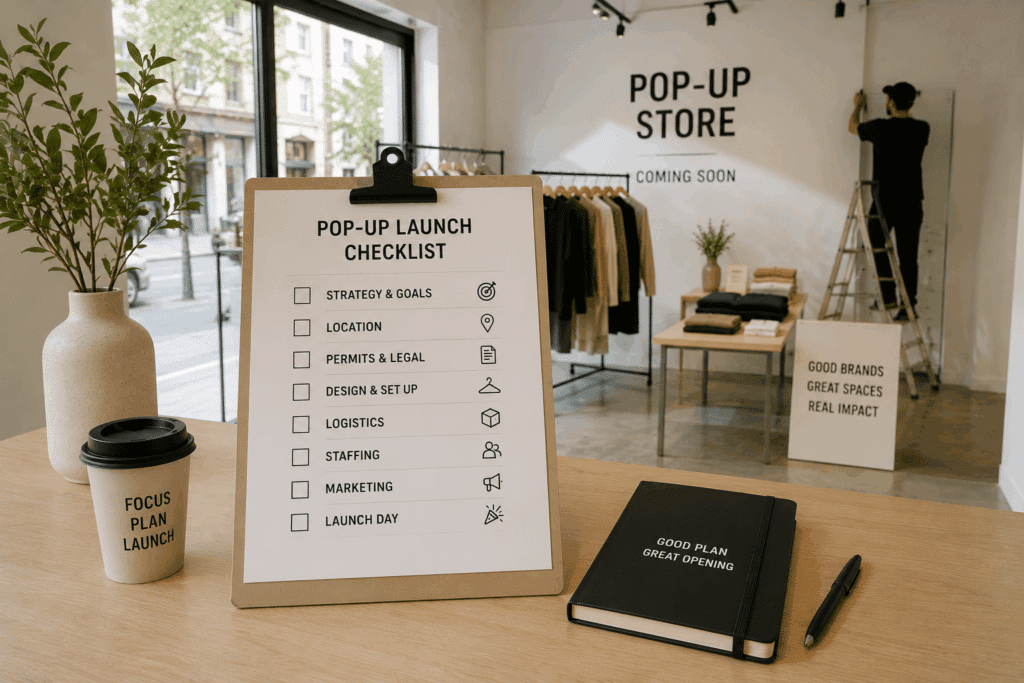
A pop-up store is a temporary commercial space used by a brand for a limited period. It may last one day, a weekend, several weeks or a few months.
Its defining feature is not an exact duration but its temporary and strategic purpose. A pop-up may be used to sell, launch a collection, enter a city, test a market, build awareness, gather a community or assess the potential of a permanent store.
The brand usually occupies an independent venue and can control the storefront, layout, design, atmosphere, programming and complete customer experience.
For a broader introduction, see the guide to what a pop-up store is and how it works.
What is a temporary shop?
In practice, temporary shop and pop-up store are usually synonyms.
“Pop-up store” is the most common international term, while “temporary shop” or “ephemeral shop” describes the same basic model.
There can be a small difference in usage: “pop-up” is often more closely associated with brand activation, experience, launches and retail innovation, while “temporary shop” can describe any short-term commercial operation, even when production is relatively simple.
Strategically, they belong to the same group: a brand occupies a space for a defined period and a specific objective.
What is a retail corner?
A retail corner works differently. Instead of occupying an independent unit, the brand uses a defined area inside another commercial establishment.
It may sit inside a department store, multi-brand retailer, concept store, shopping centre, hotel or another established retailer.
The brand may have its own furniture, products, graphics, signage and staff, but shares the environment, footfall and part of the infrastructure with the host retailer.
This reduces independence, but it can also reduce operational complexity.
The main difference between a pop-up and a corner
The distinction can be summarised simply:
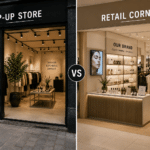
A pop-up creates its own destination. A corner enters a destination that already exists.
In a pop-up, the brand controls the location, façade, entrance, route and experience. In a corner, some of these variables depend on the host retailer, its opening hours, visual standards and customer circulation.
In return, the corner provides something valuable: existing footfall and an operating retail infrastructure.
Format comparison
| Criterion | Pop-up / temporary shop | Retail corner |
|---|---|---|
| Independent venue | Usually yes | No |
| Brand control | Very high | Medium |
| Own storefront | Usually yes | No |
| Existing footfall | Depends on the location | Provided by the host retailer |
| Customisation | High | More limited |
| Operational complexity | Medium or high | Lower |
| Market testing | Very complete | Partial |
| Immersive experience | Very high | More limited |
| Dependence on third parties | Lower | High |
Which format provides more control over the experience?
The pop-up store.
In an independent venue, the brand can decide what customers see from the street, how they enter, which product they encounter first, how they move, where they interact and how they buy.
This is particularly valuable for launches, fashion, beauty, luxury, technology and experiential retail.
A corner will rarely offer the same level of immersion because it remains part of another retailer’s ecosystem.
Which format is better for testing a market?
Generally, an independent pop-up.
A corner can provide sales and product-response data, but the results are generated within the context of the host retailer.
A pop-up can also test the brand’s ability to generate traffic, its independent physical positioning, the response to a specific location, the full customer experience and the potential of a standalone store.
This is why pop-ups are often used as a market-entry test before permanent retail.
Which format suits a digital brand?
Both can be useful, but they answer different questions.
A corner can test physical response to the product and offline sales with less infrastructure.
A pop-up can also assess whether the brand can attract customers, operate an independent store, activate its community and sustain its own physical experience.
If the question is “Can we begin selling offline?”, a corner may be enough. If the question is “Could our own store work?”, a pop-up provides a more complete answer.
Which format works best for a launch?
A pop-up offers greater creative freedom.
It can combine sales, events, demonstrations, workshops, press, creators, personalisation and content within one activation. The venue becomes part of the campaign.
A corner can also be effective when the host retailer has strong relevance with the target audience, but the level of creative control is normally lower.
Which format costs more?
There is no universal answer.
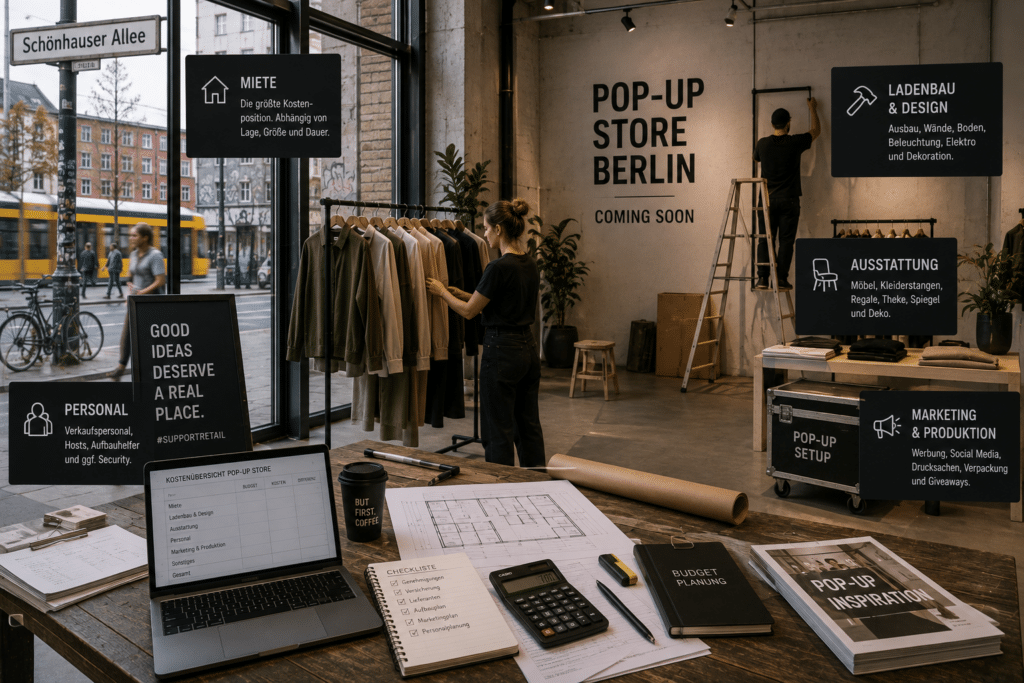
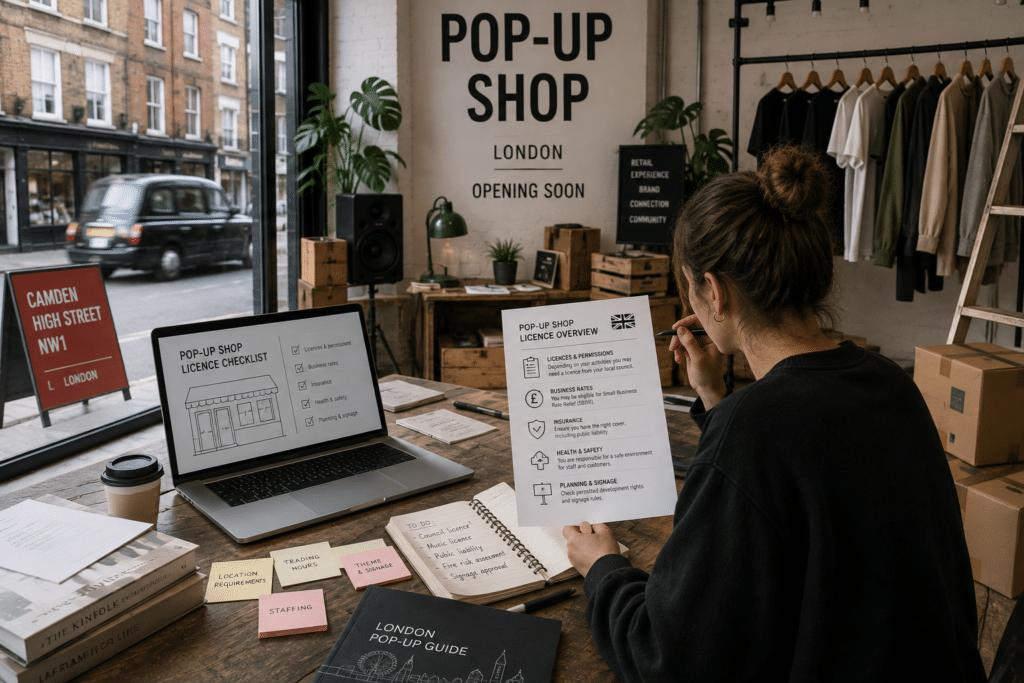
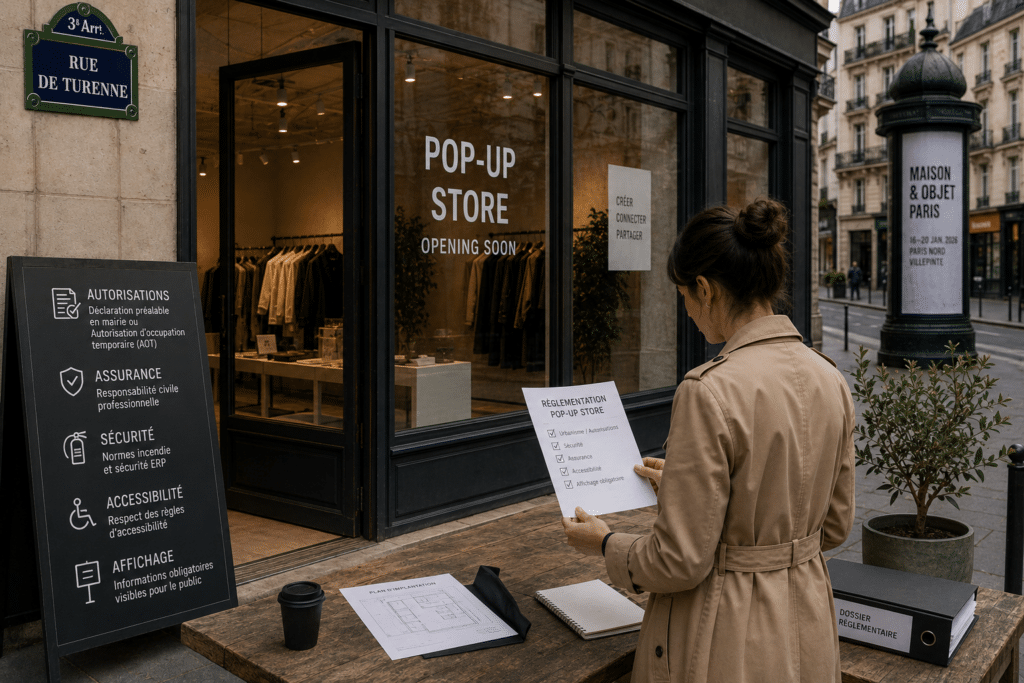
An independent pop-up may require rent, production, furniture, staffing, logistics, insurance, technology, permits, installation and dismantling.
In a corner, part of the infrastructure may be included, but the agreement may involve a fixed fee, space rental, a share of sales, minimum investment or production adapted to the retailer’s standards.
The correct comparison is not “Which format has the lowest rent?”, but what investment does each format require to achieve the objective?
What is a shop-in-shop?
A shop-in-shop is a branded store installed inside another retail establishment.
It is closely related to a corner, but it usually occupies more space, has a more developed identity and provides greater visual separation from the host retailer.
It can be understood as a continuum:
corner → shop-in-shop → independent store.
As the brand moves along this scale, its control over the space normally increases.
What is a temporary showroom?
A temporary showroom differs mainly in its objective.
Instead of focusing on spontaneous footfall and direct sales, it may target professional buyers, press, stylists, distributors, partners, creators or invited clients.
It may therefore prioritise privacy, natural light, interior quality, space, accessibility and appointment management over a prime storefront.
Which format should you choose for each objective?
- Test a new city: pop-up store.
- Try physical retail with less complexity: retail corner.
- Launch a collection with strong impact: pop-up store.
- Sell for several months inside an established retailer: corner or shop-in-shop.
- Meet press and buyers: temporary showroom.
- Create an immersive experience: pop-up or independent venue.
- Assess a future permanent store: pop-up store.
How long should each format last?
A pop-up may run for hours, days, weeks or months. Duration should follow the objective: a launch may need two days, while a market test may need several weeks.
A corner may be temporary, seasonal or maintained for longer because it shares infrastructure with another retailer.
Do not choose duration by habit. Choose the time required to obtain the result or insight the brand needs.
How to decide which format your brand needs
Before searching for spaces, answer these questions:
- What is the primary objective?
- Who needs to visit the space?
- Do you need spontaneous footfall?
- How much creative control does the experience require?
- Will there be direct sales?
- How much time does the project need?
- What do you want to learn from the market?
The answers define whether the right solution is a pop-up, showroom, corner or hybrid format.
From format selection to execution
Choosing the format is only the first step. The project may then involve venue sourcing, design, adaptation, production, furniture, staffing, logistics, POS, audiovisual equipment, permits, installation and operational management.
Go—PopUp combines access to temporary spaces with scouting and execution services for projects that need more than a venue.
You can discuss the project with the Go—PopUp agency and coordinate the activation from format selection to opening.
Pop-up store, temporary shop or retail corner: which should you choose?
Pop-up store and temporary shop describe essentially the same model: an independent temporary commercial presence.
A retail corner places the brand inside an establishment that already exists.
The first offers more independence, control and capacity to experiment. The second provides existing infrastructure, established footfall and lower operational complexity.
Neither is automatically better. The format should always follow the strategy.