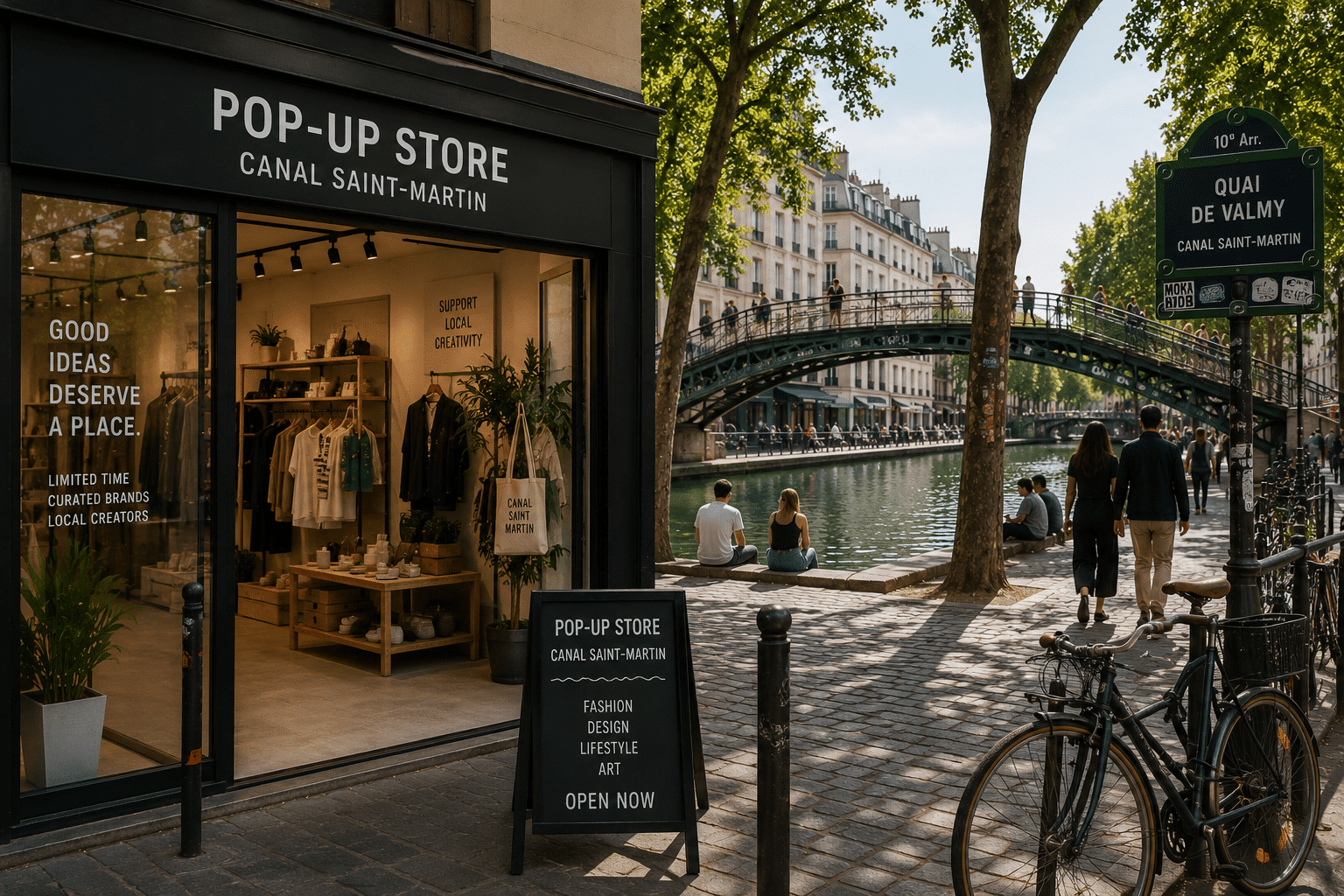

Paris has no shortage of well-known retail districts. Le Marais, Saint-Germain, Opéra and the major central shopping streets naturally play an important role in brand strategies.
But for some activations, the best location is not necessarily the most obvious one. Around Canal Saint-Martin, a different ecosystem has developed: more independent, more creative, more lifestyle-oriented and often closer to local communities.
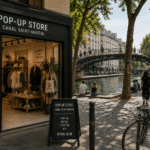
Fashion boutiques, concept stores, cafés, restaurants, galleries and cultural venues coexist along the canal and the surrounding streets. For a brand looking to open a pop-up around Canal Saint-Martin, this can be a strong alternative to Paris’s more established retail districts.
Why Canal Saint-Martin attracts brands
Canal Saint-Martin is not a traditional retail district, and that is exactly what makes it interesting. People come to walk, eat, discover new places, shop, spend time by the canal, visit cultural venues and meet friends.
That mix creates an environment where brand discovery can happen naturally. The area can be especially relevant for independent fashion, streetwear, beauty, design, responsible brands, collaborations, product launches, showrooms and community-led activations.
For international brands, a pop-up here can also be a different way to test Paris with a more local, urban and creative audience. If Paris is already part of your strategy, you can explore available pop-up spaces in Paris.
Canal Saint-Martin vs. Le Marais: what is the difference?
Both areas can work for fashion, beauty and lifestyle activations, but they communicate different things.
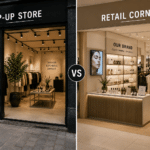
Le Marais is associated with a dense retail environment, fashion, design and a strong international customer base. Canal Saint-Martin generally offers a more relaxed, independent and locally rooted context.
Le Marais may be more relevant if you need an established commercial environment, high boutique density, premium positioning or immediate retail visibility. Canal Saint-Martin may be more relevant if you want a more independent image, a closer link to local communities, a creative context and a less conventional experience.
For a deeper comparison, see our Le Marais pop-up guide.
The best micro-locations around Canal Saint-Martin
Rue Beaurepaire
Rue Beaurepaire is one of the most natural streets for brands looking for a retail environment. It can suit fashion, accessories, footwear, DTC brands, lifestyle and compact retail formats.
For a brand that wants a commercial setting without moving into Paris’s most premium streets, it can offer a useful balance.
Rue de Marseille
Rue de Marseille is also associated with fashion and concept stores. It can work particularly well for contemporary fashion, design, responsible brands, collaborations, showrooms and creative activations.
Neighbouring businesses matter here: an independent brand can gain coherence simply by being surrounded by concepts that already speak to its audience.
Rue Yves-Toudic
Rue Yves-Toudic sits within the same network of independent businesses. It can be suitable for activations that want to feel integrated into neighbourhood life rather than function as a purely commercial destination.
This can work for beauty, fashion, lifestyle, workshops, community events and creator launches.
Quai de Valmy and Quai de Jemmapes
The quays follow a different logic. The canal is a recognised place for walking, relaxing and gathering, which can be useful for activations that are not purely retail-led.
Concepts can combine retail, events, content, community, experience and hospitality. Cultural venues in the area also reinforce this hybrid character.
What type of pop-up works well in Canal Saint-Martin?
Street-level retail unit
Best when selling is the priority. Review storefront visibility, footfall, storage, internal circulation and signage.
Showroom
A showroom can work especially well when the activation targets buyers, press, creators, partners or invited customers. In this case, interior design and atmosphere may matter more than walk-in traffic.
Temporary concept store
The district works well for formats that combine several dimensions: sales, design, content and community. A brand can integrate exhibitions, workshops, collaborations, talks and product discovery.
Event or experiential space
For launches or immersive activations, a less conventional venue may be more relevant than a traditional shop. The area supports formats around music, design, art, food and brand experience.
Which brands are the best fit?
Canal Saint-Martin is not necessarily the right choice for every brand. It can be particularly relevant for brands with a creative, independent, urban, responsible, design-led or community-led identity.
A highly premium brand seeking a tightly coded luxury environment may prefer another district. An emerging, digital or independent brand may benefit from a setting that feels more natural to its positioning.
What to check before booking
1. The type of traffic
The neighbourhood mixes residents, workers, visitors, tourists, restaurant customers, shoppers and creative communities. Analyse when people pass the venue and why they are there.
2. Visibility
For a retail activation, storefront, signage, entrance, street visibility and façade remain essential.
3. The commercial environment
Around the canal, context can matter as much as traffic. Review neighbouring brands, restaurants, cafés, concept stores, galleries and cultural venues.
4. Layout and customer flow
Assess customer flow, product display, storage, staffing, queues, fitting rooms and any event area.
5. Branding permissions
Confirm what can be changed on the storefront, walls, signage, furniture, lighting and exterior. Branding permissions should be clear before production begins.
6. Technical requirements
Power, internet, sound, lighting, heating, toilets, access and audiovisual requirements can become decisive.
7. Logistics and deliveries
Plan delivery windows, stock, setup, dismantling, supplier access and transport.
8. Permitted activity and licences
If the concept includes food, alcohol, music, events, exterior installations or use of public space, additional requirements may apply. Confirm these before final booking.
How much does a Canal Saint-Martin pop-up cost?
There is no single price. Cost depends on the street, size, storefront, duration, dates, venue condition, equipment, permitted activity and the amount of production required.
A more expensive venue that already works for the concept can sometimes be more efficient than a cheaper location that requires extensive temporary works. The real budget should be considered as venue + design + production + operations + logistics + marketing.
For a broader framework, see our guide to pop-up store costs in Paris.
Should you choose Canal Saint-Martin to reduce costs?
Not automatically. The district may offer alternatives to some of Paris’s more premium areas, but cost alone should not drive the location decision.
The real question is: does the neighbourhood audience fit the brand? A cheaper activation in the wrong area can underperform a more expensive one in a better-aligned location.
How long should the pop-up run?
One or two days
This can work for a launch, press event, creator event or product drop.
One week
A week gives more time to generate traffic, create content, combine events with sales and test audience response.
Several weeks
This can be more useful for market testing, customer acquisition, community building and sales analysis.
The duration should be long enough to answer the strategic question behind the activation.
When should you open?
Timing matters. Neighbourhood dynamics vary by season, day, time, weather and local events.
Lifestyle, community and hospitality-led activations can benefit particularly from periods when outdoor life around the canal is strongest.
How to book a pop-up around Canal Saint-Martin
Step 1: define the objective
Decide whether the project needs to sell, launch, test Paris, generate awareness, create content, build community or host an event.
Step 2: define the brief
Set dates, duration, budget, size, area, audience, activity, technical needs, storage and branding requirements.
Step 3: explore available spaces
You can explore pop-up spaces in Paris with Go—PopUp and compare formats according to project requirements.
Step 4: compare context
Do not compare only on price. Review the street, audience, neighbouring businesses, visibility, accessibility, format and production requirements.
Step 5: prepare execution
Once the venue is selected, the project may require design, production, furniture, branding, suppliers, staff, logistics, POS, audiovisual, permits, installation and on-site management.
From venue search to activation
Go—PopUp can support brands beyond the venue booking itself. Depending on the project, support can include scouting, concept, adaptation, production, local suppliers, branding, staffing, logistics, POS, audiovisual and project management.
For a more complex project, share the brief with the Go—PopUp agency.
Is Canal Saint-Martin right for your brand?
The district does not replace Le Marais or Paris’s major retail areas. It offers something different: a more independent, creative, local, lifestyle-oriented and experiential environment.
The best decision will always depend on the alignment between brand + audience + street + venue + format + timing.