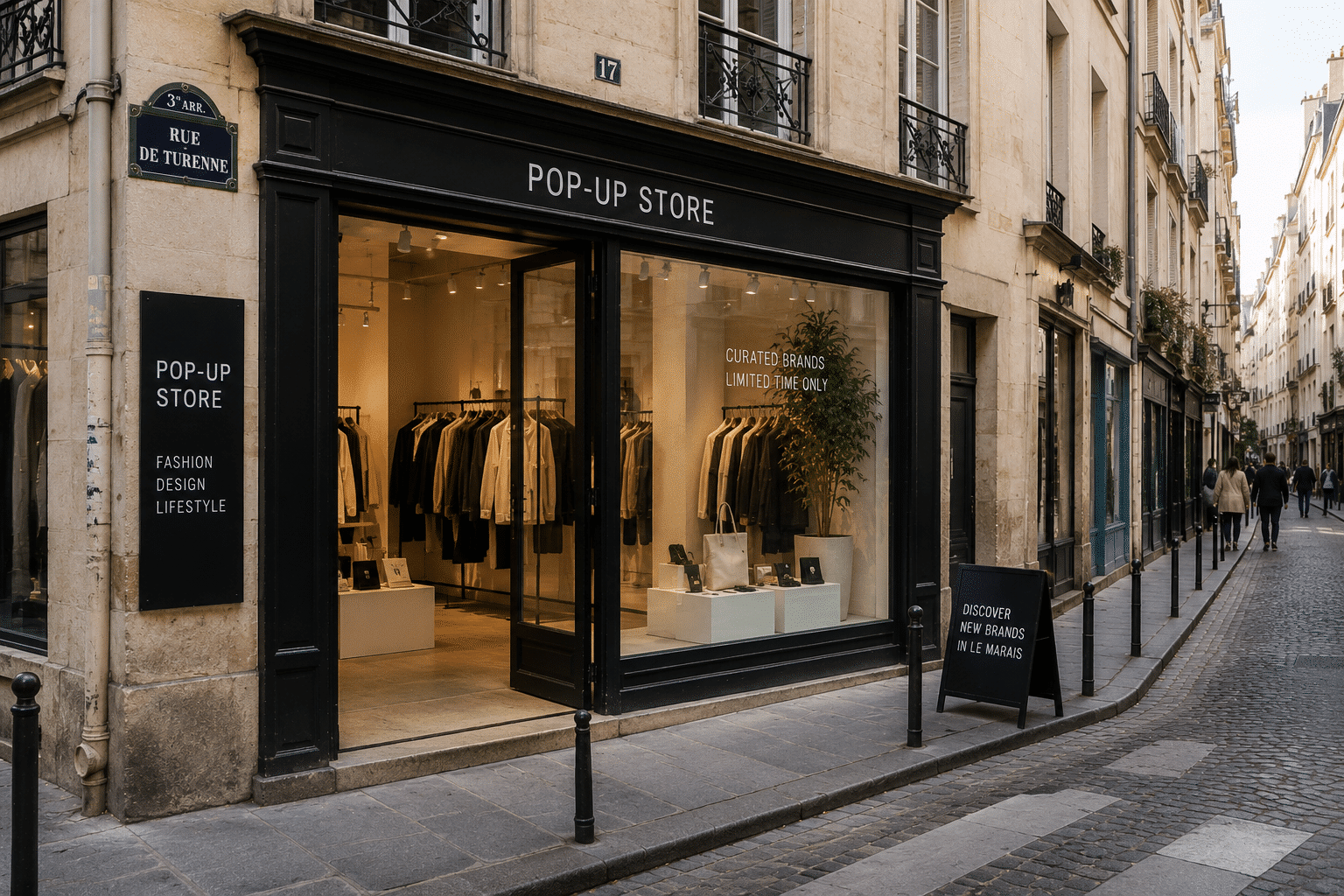

Paris is one of the world’s most influential retail destinations. But for a brand planning a temporary store, choosing Paris is only the first decision: the neighbourhood can completely change the positioning, audience and performance of the activation.
Le Marais holds a distinctive place within the city. Fashion, design, beauty, galleries, concept stores, food and heritage coexist in an environment where visitors are used to discovering new brands and ideas.
For a French or international brand considering a pop-up store in Le Marais, that combination can be especially relevant. The important point is that not every street serves the same objective.
Why Le Marais works so well for pop-up stores
Discovery is already part of the neighbourhood experience. Visitors do not come only for one specific retailer. They move between shops, galleries, restaurants, cafés and cultural venues.
That behaviour creates favourable conditions for brands that need an audience open to new concepts.
Le Marais can be particularly suitable for:
- Fashion brands.
- Accessories and jewellery.
- Beauty, skincare and fragrance.
- Design and interiors.
- Lifestyle concepts.
- Independent labels.
- DTC brands moving from digital to physical retail.
- Collection launches and limited editions.
- Showrooms and brand experiences.
For international brands, the district can also act as an entry point into the Paris market. A pop-up allows the team to meet customers, observe reactions to the product and test a physical presence without immediately committing to a permanent commercial lease.
Which parts of Le Marais are best for a pop-up?
There is no single ideal location. The commercial environment can change considerably within a few minutes.
A brand looking for maximum visibility will not necessarily have the same priorities as a design label seeking proximity to galleries and independent boutiques.
Before searching for a venue, define what the location must contribute to the activation.
Rue des Francs-Bourgeois: retail visibility and footfall
Rue des Francs-Bourgeois is one of the district’s main commercial streets. Fashion, beauty and fragrance retailers create a clearly recognisable shopping environment, and the street benefits from strong leisure traffic.
It can suit activations focused on visibility, spontaneous visits, sales, product launches, new collections and brand awareness.
In this context, the shop window and façade are part of the campaign. A large share of potential visitors may discover the brand simply by walking past, so the exterior must communicate the proposition quickly.
Rue Vieille du Temple: fashion, design and identity
Rue Vieille du Temple runs through much of the district and sits within a mix of fashion, galleries, restaurants and independent concepts.
The Haut Marais area can be relevant for contemporary fashion, premium brands, design, beauty, accessories, lifestyle and independent labels.
Here, venue selection should not be based only on footfall. The surrounding stores and galleries also contribute to how the brand is perceived.
Rue de Bretagne and Haut Marais: creativity and community
Further north, the district combines local commerce, food, galleries, design and neighbourhood life.
This area can work especially well for launches, events, workshops, collaborations, presentations and concepts that combine retail with community programming.
The pop-up no longer needs to function only as a store. It can become a meeting place between the brand and its Paris audience.
Rue de Turenne and surrounding streets: a destination-led alternative
The streets around Rue de Turenne can provide options for brands that want to remain within the Marais ecosystem without choosing the most obvious retail corridor.
A slightly quieter location may make it possible to prioritise a better interior, a more suitable surface, private appointments, events or a more immersive experience.
This is particularly relevant when the brand already has a community that will deliberately travel to the venue.
What type of space should you choose?
Street-level retail unit
This is usually the best fit when sales and spontaneous footfall are the priorities.
Review the shop window, visibility, façade width, internal circulation, storage, fitting rooms and checkout area. A visitor unfamiliar with the brand should understand the proposition quickly.
Showroom
Not every activation needs a high-traffic storefront.
If the project is mainly for press, buyers, creators, VIP customers, partners or professional appointments, a showroom may be more efficient. Interior quality, atmosphere and flexibility can matter more than the street frontage.
Gallery or event venue
Le Marais is particularly suitable for concepts where retail and culture meet.
A gallery or flexible venue can work for exhibitions, installations, launches, presentations, press events, immersive experiences and artistic collaborations.
Compact space for a launch or drop
Bigger is not automatically better.
For a collaboration, limited edition or short product launch, a small, well-located venue can create more impact than a large store that is difficult to fill and expensive to produce.
What to check before booking a Le Marais pop-up
1. The audience
Le Marais attracts Parisians, visitors from other parts of France and international customers. Analyse who actually passes the venue and at what time.
Friday afternoon traffic may differ greatly from Sunday. The objective is not only to have footfall, but to have the right footfall.
2. Visibility from the street
For a retail-led activation, review window size, entrance visibility, signage options, façade width and any elements that may obscure the venue.
3. Interior layout
Do not compare venues by square metres alone. Plan customer movement, product display, staff areas, stock, fitting rooms, queues and any event space.
A smaller but well-organised venue can perform better than a larger space with an unsuitable configuration.
4. Branding permissions
A pop-up should temporarily become a brand environment.
Confirm what can be changed across the windows, signage, walls, lighting, furniture and exterior before graphic production starts.
5. Technical infrastructure
Depending on the activation, check electricity, internet, lighting, heating or air conditioning, toilets, access, technical capacity and loading conditions.
6. Logistics
The character of the Marais streets can create operational constraints. Plan how products, furniture, production materials and technical equipment will reach the venue.
7. Permitted use and authorisations
The premises must be compatible with the activity. Food, alcohol, music, events, exterior installations or public-space use may create additional requirements.
The guide to pop-up store regulations in France explains the main questions to review before opening.
How much does a pop-up store in Le Marais cost?
There is no standard rate. The price depends on the street, exact position, size, storefront, duration, dates, condition of the venue, included equipment, technical characteristics and the production required.
In a high-demand district, it is tempting to compare spaces only by their daily rental price. That is a mistake.
The better calculation is: how much will this venue cost once it has been transformed into an operational pop-up?
A more expensive space that is already well equipped may be more efficient than a cheaper shell requiring extensive production.
The total budget may also include design, furniture, branding, staffing, transport, logistics, POS, insurance, audiovisual equipment, installation and dismantling.
For a broader budget framework, see the guide to how much a pop-up store costs in Paris.
How long should you rent the space?
Duration depends on the objective.
One or two days may work for a launch, press event or concentrated product drop. A one-week presence provides more time to generate traffic, communicate the location and combine launch activity with sales.
Several weeks may be more useful when the brand wants to test Paris, observe sales, understand customer behaviour, measure offline demand or build a stronger local presence.
The right question is not “How long does a pop-up normally last?”, but: how much time does this activation need to produce a useful result?
When should you open in Le Marais?
The calendar can directly affect performance.
Weekends can be important for concepts that rely on leisure and shopping traffic. Weekdays may be more relevant for showrooms, press appointments, buyers, professional meetings and B2B events.
Fashion, design, art and cultural periods can strengthen the relevance of an activation in Le Marais, but they also increase demand for strong venues and suppliers.
If the dates are fixed, start the venue search early.
How to book a pop-up store in Le Marais
Step 1: define the objective
Decide whether the project is intended to generate sales, launch a collection, test Paris, create content, meet the community, attract press, host an experience or receive buyers.
Step 2: prepare the brief
Define dates, duration, budget, size, audience, activity, technical needs, storage, customisation level and preferred micro-location.
Separate essential criteria from desirable features. This prevents a strong venue from being rejected for a secondary reason.
Step 3: explore available Paris spaces
You can explore pop-up spaces in Paris and compare different venue formats.
Projects that require a very specific street or unusual characteristics may need personalised scouting.
Step 4: compare strategically
Do not compare only price. Assess the audience, street, neighbouring businesses, visibility, accessibility, layout, technical constraints and production requirements together.
Step 5: prepare the execution
Once the venue is secured, the project may involve spatial design, technical plans, production, furniture, branding, local suppliers, staffing, logistics, POS, audiovisual equipment, permits, installation, dismantling and on-site management.
From venue search to activation
Finding the right space is essential, but it is not always the end of the project.
Go—PopUp combines access to temporary spaces with personalised scouting and project support. For international brands without a French team, the activation can be managed as one coordinated project from venue search to local execution.
Is Le Marais right for your next pop-up?
Le Marais combines many elements that suit temporary retail: fashion, design, beauty, culture, tourism, independent businesses and an audience accustomed to discovery.
But choosing the district is not enough. A brand seeking high footfall may prioritise Rue des Francs-Bourgeois. A premium or design-led concept may prefer Vieille du Temple and the Haut Marais. An event-led activation may need a more flexible venue on a street where destination traffic matters more than walk-ins.
The strongest decision aligns brand + audience + micro-location + space + format + timing.
If Le Marais fits the audience and Paris is part of the growth strategy, compare available spaces in Paris or develop a more specific brief with the Go—PopUp agency.