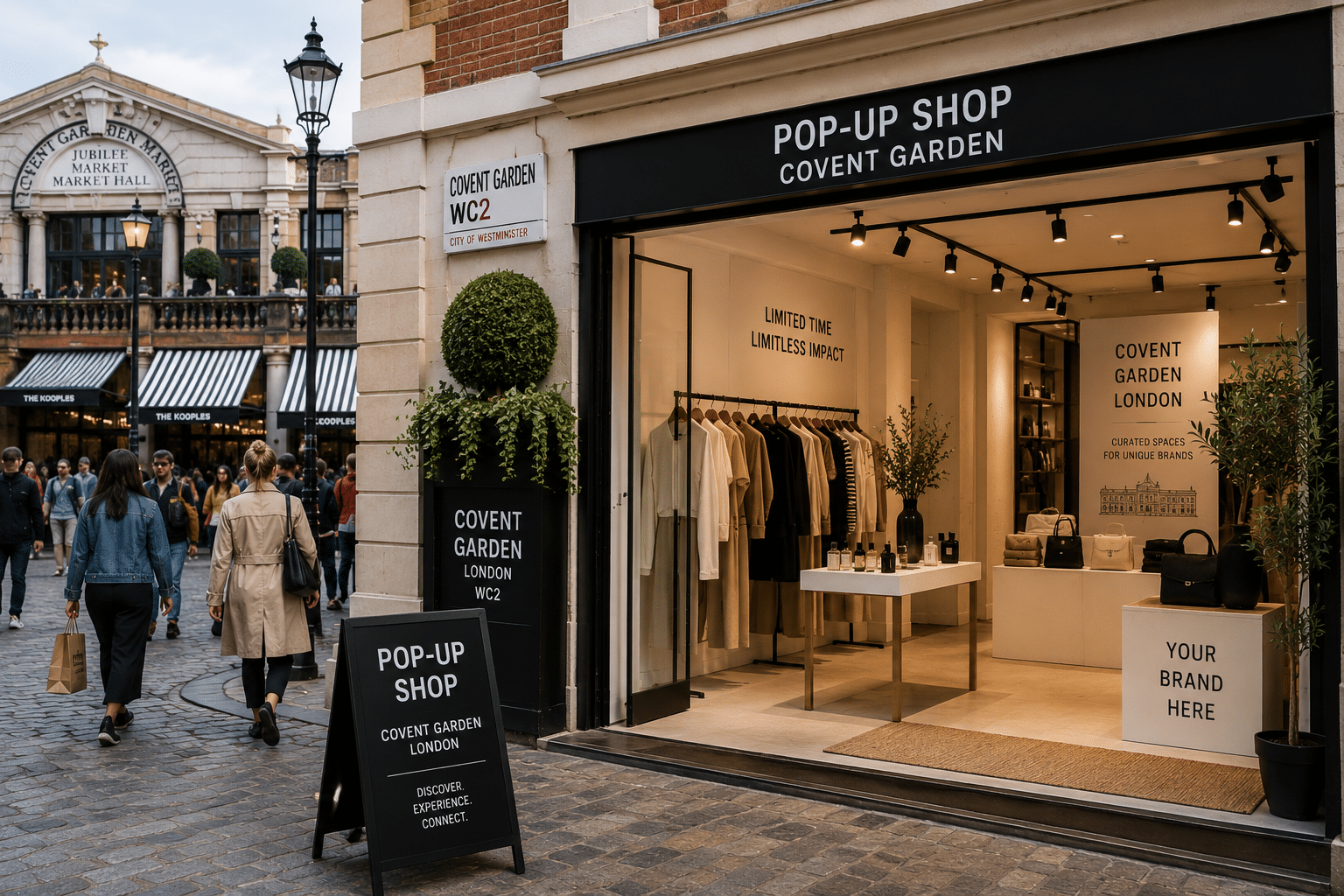

Covent Garden is one of London’s most recognisable retail destinations. It combines fashion, beauty, lifestyle, hospitality, theatres and a constant flow of local and international visitors.
That mix can make the area highly attractive for a temporary store, but choosing Covent Garden is not enough. A unit close to the Piazza serves a different purpose from a boutique in Seven Dials or an appointment-led showroom nearby.
This guide explains the main micro-locations, venue formats, costs and booking criteria for a successful Covent Garden pop-up.
Why Covent Garden works for pop-up retail
Covent Garden is both a shopping destination and a wider leisure destination. Visitors come for retail, restaurants, theatres, culture and the West End experience.
This can make the district particularly relevant for:
- Fashion and accessories.
- Beauty and skincare.
- Jewellery and lifestyle brands.
- Product launches and limited editions.
- DTC brands testing physical retail.
- International brands entering London.
- Experiential activations.
- Press, creator and community events.
A pop-up can generate sales, but it can also provide information about customer profiles, conversion, product demand, pricing and the potential for a longer-term London presence.
The main Covent Garden areas to compare
The Piazza and surrounding streets: maximum visibility
The streets around the Piazza sit at the centre of the district and can offer strong consumer visibility.
They may suit activations that prioritise footfall, awareness, tourist traffic, spontaneous discovery and direct sales.
For these concepts, the storefront matters. Large windows, a clear entrance and permitted exterior branding help the venue communicate the proposition quickly.
Seven Dials: fashion, beauty and independent character
Seven Dials provides a more curated context associated with fashion, beauty, streetwear and independent retail.
It can be particularly relevant for contemporary fashion, footwear, accessories, beauty, lifestyle brands, DTC concepts and limited drops.
For some brands, the surrounding commercial mix can provide a stronger fit than the busiest possible central unit.
Neal Street and Monmouth Street: discovery-led retail
Customers around Neal Street, Monmouth Street and Seven Dials are often already in a browsing mindset.
This can benefit fashion, sneakers, accessories, beauty, design and collaboration-led concepts that rely on discovery rather than only destination traffic.
Neal’s Yard: small, distinctive concepts
Neal’s Yard has a specific visual and commercial identity built around independent shops, food, wellbeing and hospitality.
It will not suit every brand, but it can provide a memorable context for wellness, beauty, lifestyle, food-related concepts and small-format community activations.
Long Acre and the wider commercial area: access and volume
Long Acre connects Covent Garden with major West End routes and provides a more conventional commercial environment.
It can work for larger consumer launches, fashion, beauty, technology and concepts that value accessibility and broader traffic.
What type of space should you choose?
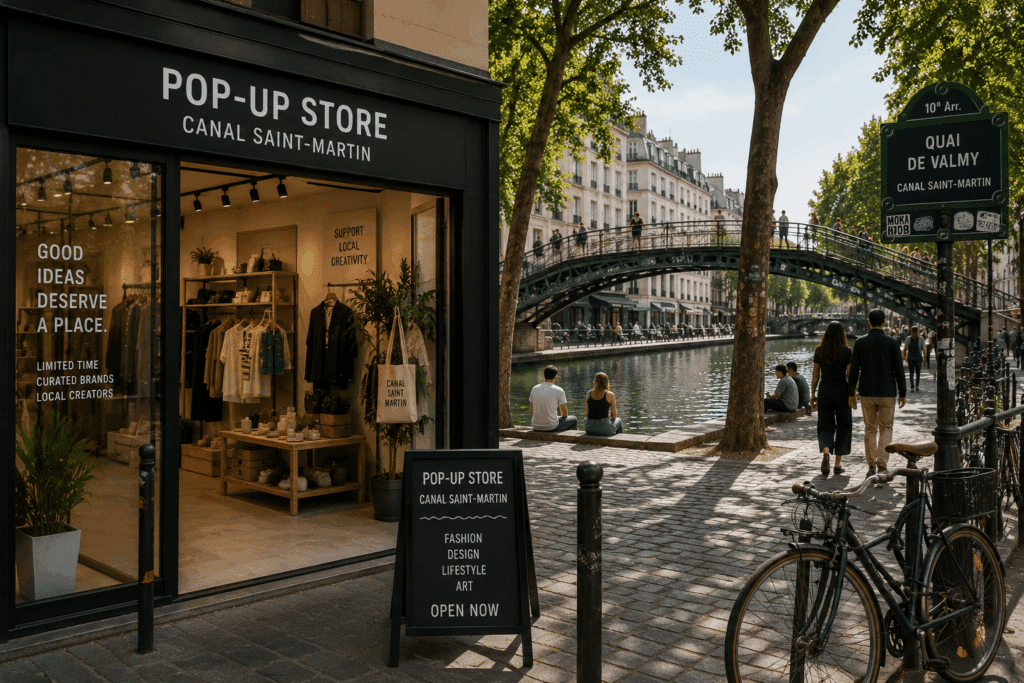
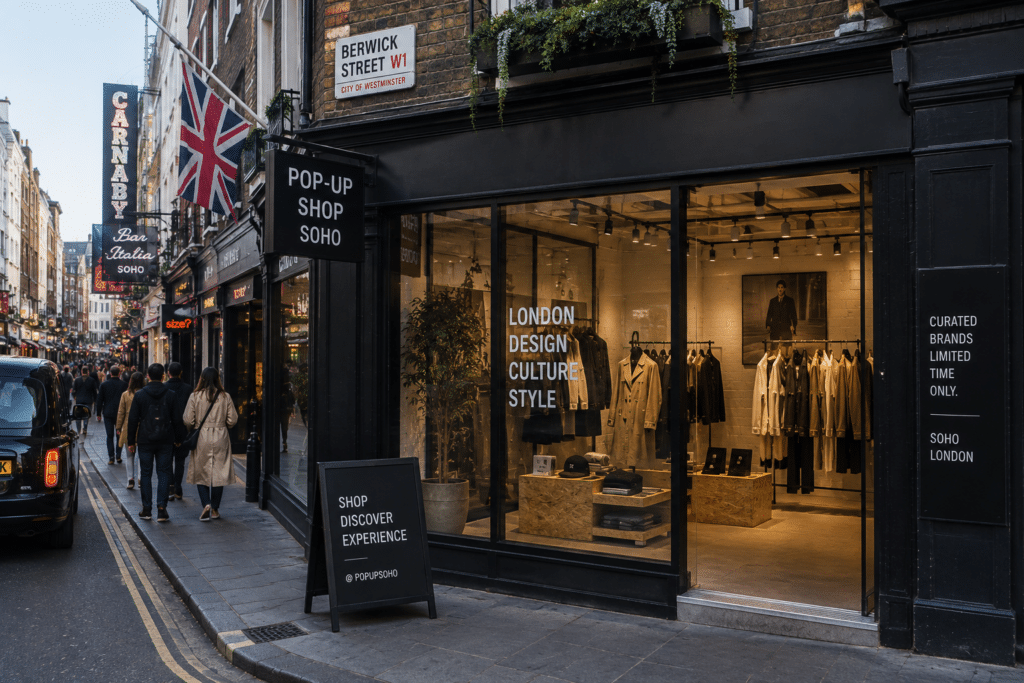
Street-level retail unit
Best when sales and walk-in traffic are the priorities.
Review the storefront, windows, storage, lighting, customer circulation, fitting rooms and checkout area.
Showroom
A showroom may be more efficient when the activation is aimed primarily at buyers, press, creators, VIP customers or appointments.
Interior quality, privacy and accessibility can matter more than premium street frontage.
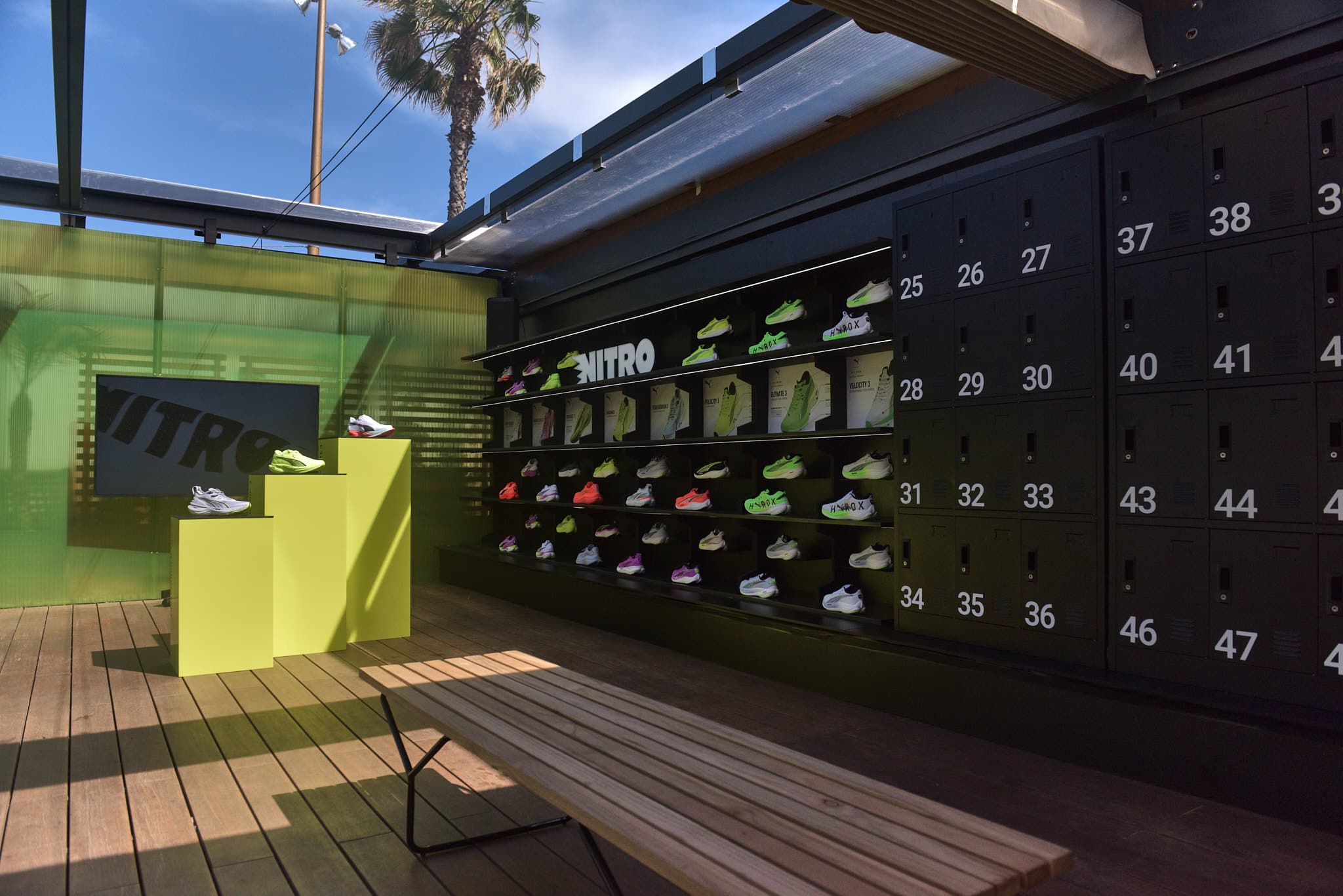
Event or experiential venue
Some launches combine retail, content, events and community.
For product demonstrations, workshops, immersive installations and presentations, technical infrastructure and layout may be more important than conventional retail fixtures.
Small-format store
A compact venue can reduce rental and production costs, create urgency and focus the customer journey.
More square metres do not automatically create more impact.
What determines the cost of a Covent Garden pop-up?
There is no standard daily rate.
The cost depends on:
- The exact street and micro-location.
- Footfall and audience quality.
- Size and layout.
- Storefront and visibility.
- Duration and dates.
- Existing fit-out and included equipment.
- Branding permissions.
- Technical and production requirements.
Covent Garden’s West End position means that highly visible retail units can command a premium.
Rent should not be evaluated in isolation. A lower-priced empty venue can require substantial spending on furniture, lighting and production, while a higher-priced space that already fits the concept may be more cost-efficient.
For a full budgeting framework, see the guide to how much a pop-up shop costs in London.
What should the total budget include?
Depending on the activation, the budget may also need to cover:
- Store design and furniture.
- Branding and production.
- Installation and dismantling.
- Staffing and security.
- Transport, stock and storage.
- POS and connectivity.
- Audiovisual equipment.
- Insurance, cleaning and permits.
- Marketing and content.
The relevant calculation is the total cost of turning the venue into a functioning activation, not simply the rent per day.
What to check before booking
1. Footfall quality
Covent Garden attracts London residents, tourists, office workers, theatre audiences, shoppers and restaurant customers.
The key question is not only how many people pass, but how many relevant customers pass.
2. Visibility
For walk-in retail, review window size, entrance visibility, signage options, sightlines and exterior branding permissions.
3. Neighbouring brands
Nearby retailers influence how the activation is perceived. Fashion, beauty and lifestyle brands may benefit from proximity to complementary concepts.
4. Internal configuration
Plan customer flow, displays, staff areas, storage, fitting rooms, queues and any event space.
5. Existing fit-out
Lighting, rails, shelving, counters, mirrors, furniture and storage can materially reduce production costs.
6. Branding permissions
Confirm what can be changed across the windows, fascia, signage, walls, lighting and exterior elements before production begins.
7. Logistics
Central London can complicate deliveries, supplier access, installation, dismantling and waste collection. Resolve these constraints early.
8. Activity and permissions
Alcohol, food, music, entertainment, outdoor installations and promotional activity may create additional requirements.
The guide to UK pop-up shop licensing and regulations covers the main questions to review.
How long should the pop-up run?
One or two days may work for press events, product launches, private presentations and concentrated drops.
A one-week pop-up provides more time to build awareness, generate organic visits, create content and combine launch activity with sales.
Several weeks can make more sense when the objective is to test London, understand normal sales patterns, build local awareness or assess permanent-retail potential.
The shortest activation is not automatically the most cost-effective. It must be long enough to answer the project’s business question.
When should you launch?
Timing can significantly affect performance.
Weekends can bring strong leisure traffic, while weekdays may be more useful for press appointments, showrooms and B2B activity.
Fashion, beauty, design, culture, Christmas retail and major London events can concentrate relevant audiences, but they also increase competition for venues and suppliers.
If the dates are fixed, begin sourcing early.
Covent Garden, Soho or Shoreditch?
Each district serves a different positioning:
- Covent Garden: established West End retail, tourism, beauty and broad consumer visibility.
- Soho: centrality, fashion, entertainment and cultural relevance.
- Shoreditch: independent retail, streetwear, creative concepts and experimentation.
The strategic question is not which neighbourhood is “best”, but which one gives the brand the strongest combination of audience, positioning and operating fit.
How to book a Covent Garden pop-up
- Define the objective: sales, launch, awareness, content, community, press or market testing.
- Build the venue brief: dates, duration, audience, size, budget, technical needs, storage and branding.
- Explore London spaces: compare available pop-up spaces in London.
- Compare total value: audience, footfall, visibility, fit-out, logistics and production—not only the daily rate.
- Plan execution: design, suppliers, staffing, permits, logistics, installation and on-site management.
From venue search to execution
Finding the right space is only the beginning.
Go—PopUp combines temporary-space sourcing with personalised scouting and project support for brands that need concept development, adaptation, production, local suppliers, staffing, logistics and operational coordination.
International brands without a UK team can develop the complete brief with the Go—PopUp agency.
Is Covent Garden right for your next pop-up?
Covent Garden combines retail, tourism, fashion, beauty, hospitality, entertainment and central-London visibility.
It can be highly effective for brands that need broad consumer exposure, but it should not be selected simply because it is famous.
The right decision aligns brand + audience + micro-location + venue + format + timing.