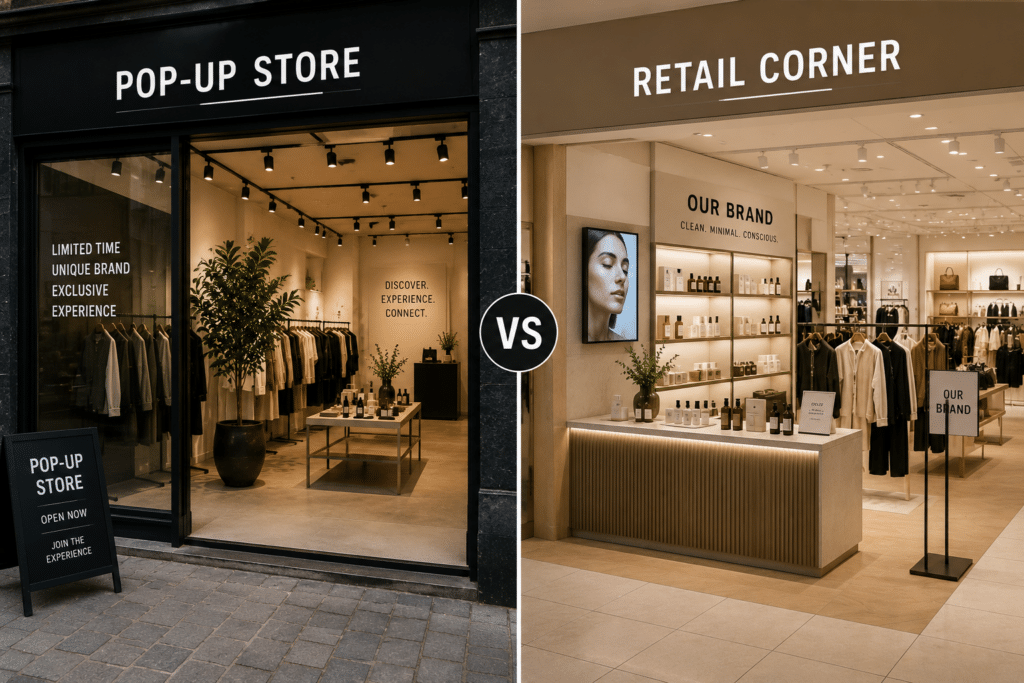
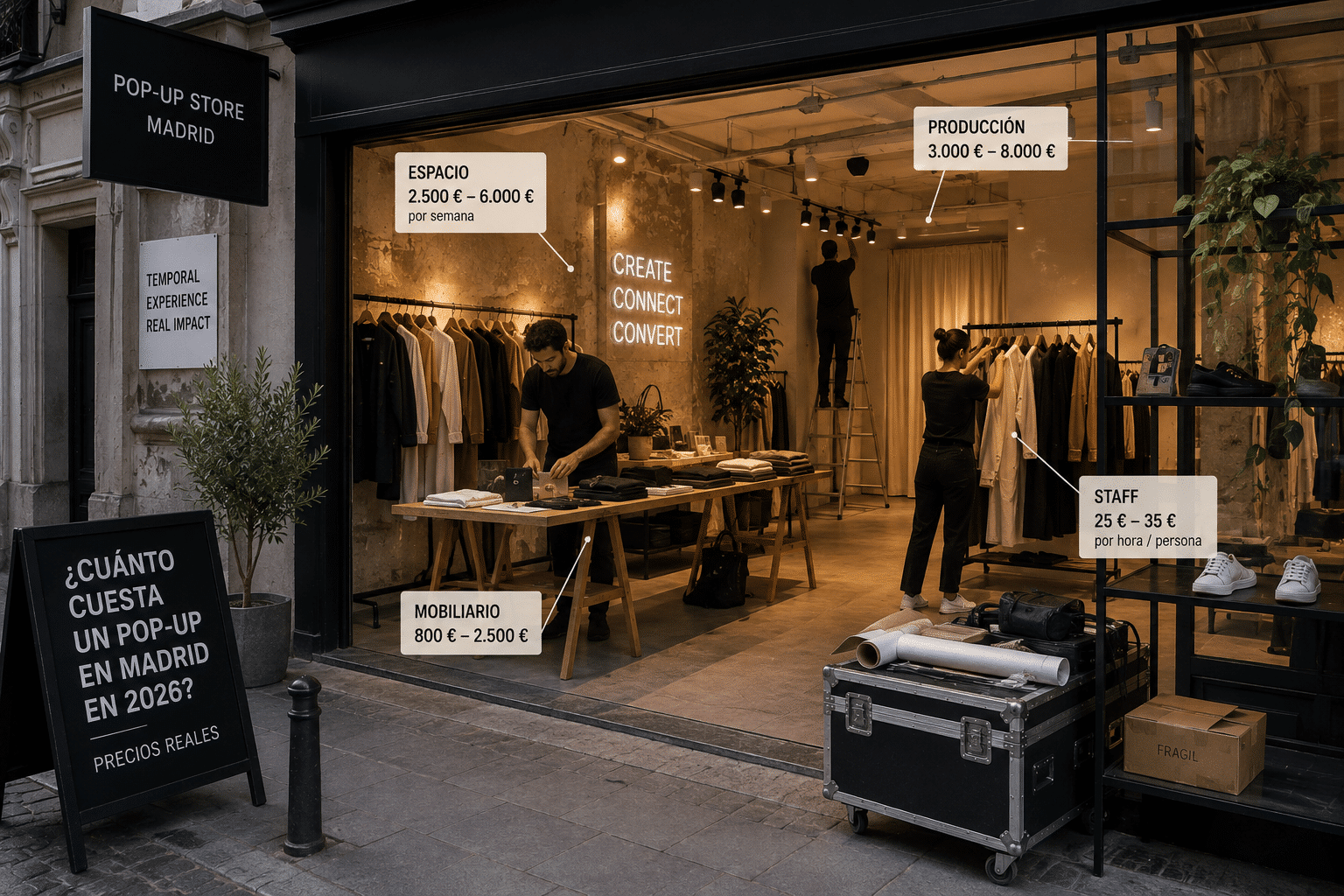

One of the first questions a brand asks when considering temporary retail is: how much does a pop-up store cost in Madrid?
There is no single rate. A compact showroom, a street-level shop in Malasaña and a large central venue can require completely different budgets.
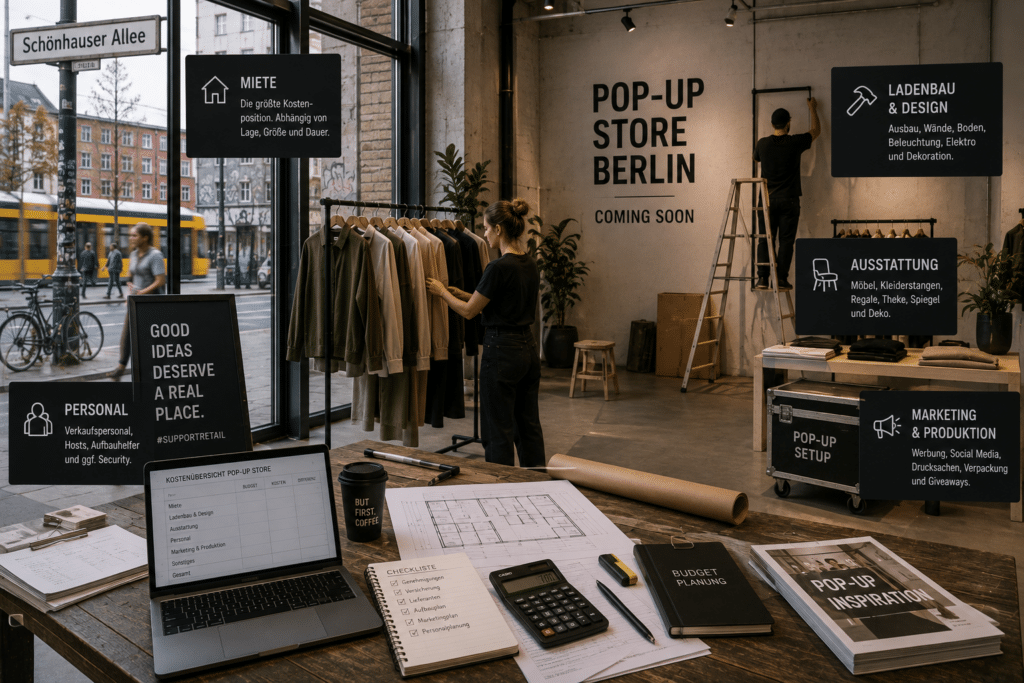
Rent is also only one part of the investment. Design, furniture, production, staffing, logistics, branding, insurance, technology, permits, installation and dismantling can make two projects with similar venue costs end up with very different totals.
The more useful question is therefore: what will it cost to make the pop-up this brand actually needs operational?
How much does it cost to rent a pop-up space in Madrid?
Temporary-space prices in Madrid vary according to the exact neighbourhood, street, size, storefront, duration, dates, condition of the venue and what is included.
Public listings may range from relatively accessible spaces for small activations to premium central units costing well over €1,000 per day. These figures refer to individual venues rather than to a citywide average, and availability and conditions can change.
For a real project, the most reliable approach is to compare available pop-up spaces in Madrid for the required dates and then calculate the full cost of making each option ready to open.
What price range should a brand expect?
As a planning framework, Madrid venues can be grouped into three broad levels. These are not fixed market rates, but useful ways to understand how the brief changes the budget.
Lean or small-format pop-up
A compact space with an existing fit-out may work for an emerging brand, workshop, presentation, appointment-led showroom or short retail test.
The main advantage is not necessarily the lowest rent. It is the ability to open with limited production and a small team.
Mid-range branded pop-up
This level usually includes street-level venues with stronger visibility, more space and better commercial positioning.
It can suit fashion, beauty, lifestyle and product activations that need a recognisable storefront, a clear customer journey and several days or weeks of trading.
Premium activation
Large or highly visible central venues can command a significant premium. They may be appropriate for international launches, high-impact campaigns or projects where the physical location itself is part of the media strategy.
A higher rental cost is justified only when the audience, visibility and production possibilities support the objective.
What determines the price of a Madrid pop-up?
1. Neighbourhood and micro-location
Sol, Gran Vía, Salamanca, Chueca, Malasaña and the different sections of Fuencarral do not serve the same audiences or commercial purposes.
A more expensive address makes sense only when it contributes to the project. An appointment-only showroom may not need thousands of passers-by. A consumer launch built around spontaneous visits may depend on exactly that.
2. Size and layout
More square metres usually mean higher rent, but they also increase the need for furniture, lighting, branding, staffing, cleaning and production.
A venue that is larger than the concept requires can weaken the budget across the entire activation.
3. Visibility and storefront
A wide shop window, recognisable façade or corner position can increase the commercial value of a venue.
For a sales-led pop-up, the storefront acts as a physical media asset. For a private event or B2B showroom, paying a premium for it may add little value.
4. Dates
Demand changes throughout the year. Fashion, art, design, food and major commercial moments can reduce availability and increase competition for the strongest spaces.
The less flexible the dates, the earlier the venue search should begin.
5. Duration
A one-day activation and a one-month booking do not always carry the same effective daily rate. Owners may offer different commercial terms for longer stays.
Compare the total cost of the required period rather than simply multiplying an advertised daily figure.
6. Existing fit-out
A venue that is close to ready-to-use can save substantial production costs.
A cheaper empty shell may need painting, lighting, furniture, temporary construction, graphics and technical work. The lower rent can therefore lead to a higher overall investment.
Rent is only one part of the budget
Imagine a venue costing €500 per day for seven days. The rental calculation is €3,500, but the project will not necessarily cost €3,500.
The brand still has to turn the venue into a working retail or activation environment.
A useful total-cost formula is:
space + design + production + operations + logistics + communications.
The main costs of a pop-up store
Venue hire
Confirm exactly what the rate includes: utilities, furniture, storage, cleaning, service charges, access hours and any owner-provided equipment.
Design and adaptation
A simple activation may reuse most of the existing fit-out. A more ambitious project can require layout design, technical drawings, carpentry, custom structures, lighting and installations.
Furniture
Rails, tables, counters, shelves, mirrors, seating and product displays must be included, hired or produced.
Branding
Window graphics, signage, interior graphics, wayfinding and branded installations help ensure that the venue feels like the brand rather than a room rented for a few days.
Production, installation and dismantling
Everything designed must be fabricated, transported and installed. At the end, the venue often needs to be returned to its original condition.
Staffing
Depending on the project, the team may include sales staff, brand ambassadors, hosts, security, a store manager and an on-site project lead.
Logistics
Transport, deliveries, storage, stock handling, replenishment, collection and waste removal all need to be planned.
POS and technology
A retail activation needs payment systems, devices and reliable connectivity. Interactive experiences may also require screens, projections, audio or specialist lighting.
Permits, insurance and compliance
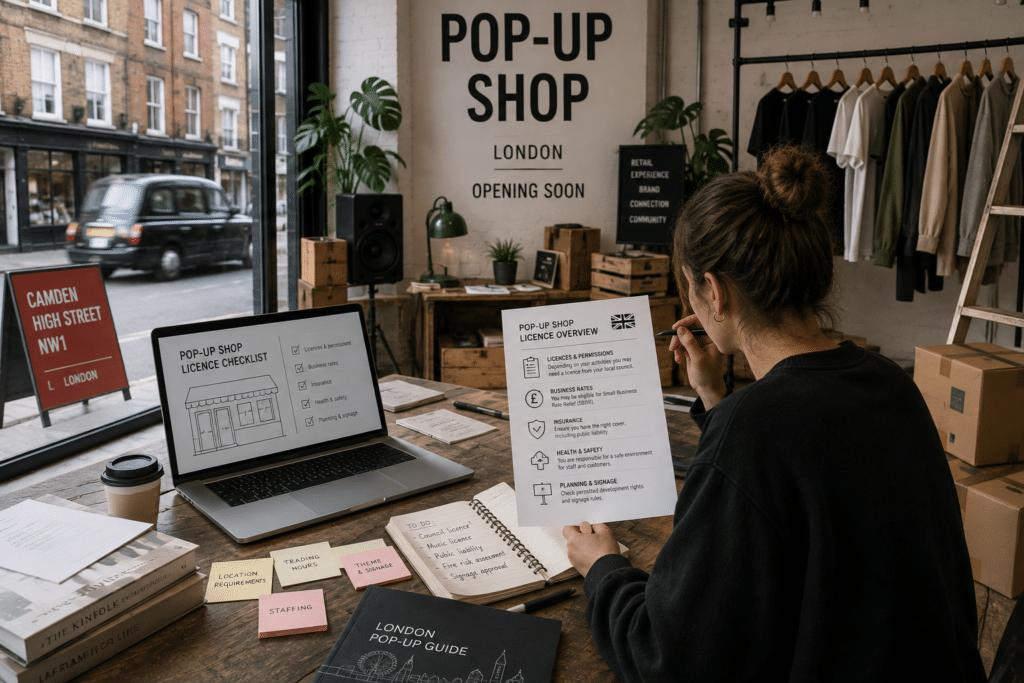
Food, alcohol, music, events, exterior installations and certain technical elements may create additional permit or insurance requirements.
Cleaning and maintenance
This is rarely the largest cost, but it becomes increasingly important for high-traffic or multi-week activations.
Three typical Madrid pop-up budgets
1. Lean market test
A DTC brand wants to understand how its products perform offline. The project uses a small or medium-sized venue, existing furniture, light branding, a compact team and a short duration.
The objective is learning rather than building a temporary flagship.
2. Branded retail pop-up
A fashion, beauty or lifestyle brand is launching a collection. It may need a good location, visible storefront, custom branding, furniture, staff, POS, stock logistics and installation.
Rent remains important, but design and operations carry much more weight.
3. Premium brand activation
An international brand planning a high-impact Madrid launch may require a premium location, personalised scouting, creative concept, store design, custom production, technical installations, audiovisual equipment, staffing, security, logistics and local project management.
At this level, the project is a complete physical activation, not simply a temporary shop rental.
How to build a realistic pop-up budget
Divide the investment into five sections:
- Space: venue hire and costs directly associated with securing it.
- Design and production: concept, furniture, branding, fabrication, technical requirements and installation.
- Operations: staffing, security, POS, cleaning and day-to-day management.
- Logistics: transport, storage, stock, replenishment and dismantling.
- Communications: content, media, PR, creators and activity designed to generate traffic.
This prevents one of the most common budgeting mistakes: spending too much on the venue and leaving too little to activate it properly.
How to reduce costs without losing impact
- Choose a venue that already fits the concept: a higher rent can be more efficient if little adaptation is required.
- Avoid unnecessary square metres: every additional metre creates follow-on production and operating costs.
- Reuse existing furniture: inspect the venue before producing new elements.
- Keep the concept focused: a pop-up does not need to be a shop, exhibition, event venue and content studio at the same time.
- Stay flexible on the micro-location: moving a few streets can improve the balance between audience, space and budget.
- Plan early: late searches reduce choice across both venues and suppliers.
Is a pop-up cheaper than a permanent store?
The two formats should not be compared only by daily cost.
A pop-up can have a relatively high short-term cost because rent, production and operations are concentrated into days or weeks. Its strategic advantage is flexibility.
A brand can test Madrid, validate offline demand, compare neighbourhoods, launch a collection and assess the potential of permanent retail without committing immediately to a long-term commercial lease.
How long should a Madrid pop-up run?
The correct duration follows the objective.
One or two days may be enough for a launch, press event or limited product drop. A week provides more time to generate traffic, content and sales. Several weeks are usually more useful for retail testing, customer acquisition and market validation.
Do not automatically choose the shortest duration. If the activation closes before it can answer the central business question, the lower budget may deliver less value.
How to find a venue within the budget
Define the objective, dates, duration, audience, preferred neighbourhoods, approximate size, technical needs, branding requirements and total budget before starting the search.
Then decide how much of that total investment can realistically be allocated to the venue.
You can compare pop-up spaces in Madrid and assess different options according to the brief.
If the project needs a highly specific street or a broader execution partner, the Go—PopUp agency can support scouting, design, production and operations.
Madrid neighbourhoods: choosing the right context
The location should follow the audience and positioning. For brands considering a creative, independent central district, the Malasaña pop-up guide explains the main micro-locations and operating considerations.
Other projects may be better served by Chueca, Salamanca, the central retail corridors or a destination venue elsewhere in the city.
How much does a pop-up store cost in Madrid? Key takeaway
There is no single figure that accurately answers the question.
The total cost depends on:
neighbourhood + micro-location + venue + duration + fit-out + production + operations.
The cheapest available space is not automatically the most cost-efficient choice. Start with the objective, define what the activation needs and compare the full cost of making each venue operational.