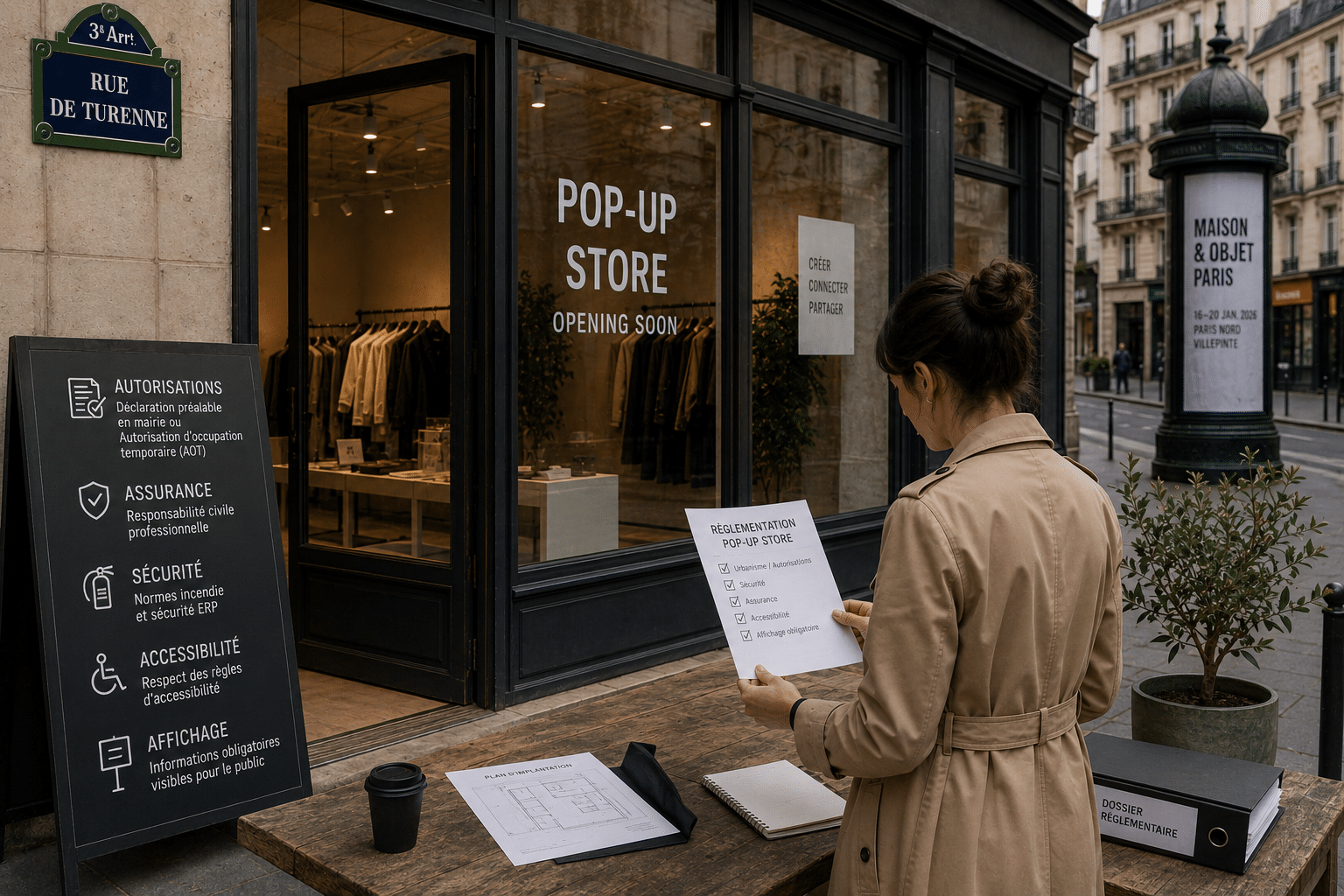

Opening a pop-up store in France can be an effective way to test a market, launch a collection or create a physical brand experience without committing immediately to permanent retail.
But temporary does not mean unregulated.
A store open for only a few days or weeks may still be subject to requirements related to public access, fire safety, accessibility, building works, signage, alcohol sales or food handling, among others.
The good news is that France does not have one single universal “pop-up store licence” that every temporary store must obtain.
The rules depend mainly on three things:
- the venue you choose;
- the activity you plan to run;
- the changes you make to the space.
Before booking a venue, the priority should therefore be making sure the space is actually compatible with the activation you want to build.
Here are the main regulatory points brands should review before launching a pop-up store in France.
Do you need a specific licence to open a pop-up store in France?
Not necessarily.
The temporary nature of the store does not, by itself, create a specific “pop-up licence”.
However, the project is still subject to the rules that apply to the commercial activity and the type of venue being used.
A brand simply displaying and selling products inside an existing retail unit will not face the same requirements as a brand transforming a raw space, serving alcohol, hosting events or installing elements on public land.
The first question should therefore not be:
“Which pop-up licence do we need?”
It should be:
“Is this venue and this activity compliant with what we actually want to do?”
1. Check that the venue can host your activity
Before signing anything, understand what the venue genuinely allows.
A visually appealing space in a strong location is not automatically suitable for every activation.
You should review:
- the authorised use of the venue;
- its capacity;
- available facilities;
- access conditions;
- any restrictions imposed by the owner;
- the activities that can take place there;
- which works or temporary modifications are permitted.
This is particularly important for international brands running their first activation in France.
A detailed brief helps avoid booking a venue first and discovering later that part of the concept cannot legally or operationally be executed there.
If you are planning an activation in the capital, you can explore pop-up spaces in Paris and compare different venue characteristics before selecting your location.
2. ERP rules: safety and public access
A store welcoming customers may fall under French regulations for ERP — Établissements Recevant du Public, or establishments open to the public.
ERP regulations are designed, among other things, to ensure safe evacuation, emergency access and fire protection.
In practice, this means that before opening a temporary store, you should confirm that the venue is suitable for the expected public use and that your temporary installation does not compromise its compliance.
This becomes particularly important if you significantly alter the layout or install temporary structures that affect visitor circulation.
3. Accessibility requirements
ERP regulations also include accessibility obligations.
So a venue should not only work aesthetically.
The way visitors enter and move through the space also needs to be considered.
Depending on the venue and the modifications planned, accessibility requirements may affect:
- entrance design;
- circulation routes;
- furniture placement;
- temporary structures;
- customer areas.
This is something to review before production starts, because late changes can affect budget, design and opening dates.
4. Do you need authorisation for building works?
It depends on the work.
Installing a few rails and decorative elements is very different from modifying a façade, changing the internal layout or carrying out technical installations.
Where works affect an ERP or significantly alter the venue, administrative authorisation may be required.
The safest approach is simple:
do not assume that a temporary installation is automatically exempt from formalities.
Before production, check:
- what the owner allows;
- what the venue can accommodate;
- whether administrative approval is needed;
- whether the works affect fire safety or accessibility.
5. Can you modify the façade and install signage?
This is especially important for pop-ups.
Temporary retail usually relies heavily on visual identity: window graphics, logos, signage, lighting and temporary façade treatments help transform a generic venue into a branded environment.
But temporary branding does not mean everything can be installed freely.
Signage in France is regulated under environmental law and may also be subject to local municipal rules.
Paris, for example, has its own local advertising and signage regulations.
This means a brand may need to check whether an exterior sign, illuminated installation or temporary façade treatment requires approval before it is produced.
In practical terms:
never design the exterior first and check the rules afterwards.
Signage should be part of the venue compliance review.
6. What about illuminated signs?
Illuminated signage can be subject to additional restrictions.
Depending on the municipality, there may be rules around:
- operating hours;
- brightness;
- placement;
- energy use;
- façade integration.
This matters if the visual concept relies heavily on light boxes, LED elements or nighttime visibility.
If exterior lighting is an important part of the activation, verify the local rules before finalising the design.
7. Can you place elements outside the pop-up?
Not automatically.
As soon as your activation extends beyond the private venue and uses a pavement, square or other public area, additional rules may apply.
Temporary occupation of public space generally requires prior authorisation.
Depending on the project, this may apply to:
- branded installations;
- temporary structures;
- outdoor furniture;
- queue management elements;
- commercial activities;
- certain event formats.
The pavement outside your store should therefore never be treated as an automatic extension of the venue.
8. Pop-ups on public space follow different rules
There is an important distinction between:
a pop-up inside a private commercial venue
and
a temporary brand activation taking place directly on public land.
Commercial activity on public space is usually subject to specific municipal procedures and authorisations.
For a brand activation, the exact legal framework will depend on:
- the city;
- the type of activity;
- the duration;
- the installation;
- whether sales take place;
- whether the event is promotional.
This needs to be clarified very early in the planning process.
9. Can you sell alcohol in a pop-up store?
Alcohol changes the regulatory profile of the project.
In France, selling alcoholic drinks generally requires the appropriate licence or authorisation depending on:
- whether alcohol is consumed on site;
- whether it is sold for takeaway;
- the type of alcohol;
- the nature of the event.
Some temporary events can fall under specific authorisation regimes rather than a standard permanent licence.
The key rule for brands is simple:
do not treat alcohol as a minor add-on to the activation.
Even if drinks are only intended for a launch event, the applicable rules should be checked in advance.
10. What if the pop-up serves food?
Food creates another layer of compliance.
Depending on the activity, French rules may cover:
- hygiene;
- food storage;
- temperatures;
- equipment;
- waste management;
- staff practices;
- traceability;
- handling of animal-origin products.
Certain activities involving food of animal origin may also require declarations to the relevant authority.
A coffee corner, tasting experience or retail-and-food concept should therefore be treated as a genuine operational part of the project, not just a decorative feature.
11. Music, events and programming inside the pop-up
Many temporary stores today are no longer just stores.
They combine:
retail + launch + event + community + content.
That is often exactly what makes the format effective.
But every additional activity can introduce new requirements.
If you plan to host:
- a DJ set;
- live music;
- a launch party;
- amplified music;
- a large event;
- audiovisual installations;
- high visitor volumes;
you should review the rules linked to the venue and the activity.
This may involve:
- capacity;
- fire safety;
- noise;
- opening hours;
- music rights;
- technical requirements.
Your venue brief should describe everything that will actually happen during the activation, not only the retail element.
12. Are the rules the same in Paris, Lyon, Marseille and Bordeaux?
Not completely.
Some regulations apply nationally across France.
Others are controlled locally.
Municipal variation is particularly relevant for:
- signage;
- outdoor advertising;
- public-space occupation;
- terraces;
- local permits;
- planning rules.
A procedure that applies in Paris should therefore not automatically be assumed to apply in exactly the same way in Lyon, Marseille or Bordeaux.
Always check the rules of the city where the activation will take place.
13. Do international brands follow the same rules?
Yes.
Operating temporarily in France does not exempt an international brand from the local rules that apply to the project.
The difficulty is usually not understanding that regulation exists.
The challenge is identifying:
which rules apply to this specific activation, in this venue, in this city.
For an international brand, several operational areas may overlap:
- venue search;
- contracts;
- local production;
- store adaptation;
- safety;
- signage;
- suppliers;
- staffing;
- logistics;
- insurance;
- activity-specific licences and permits.
This is why these requirements should ideally be defined before the final venue is selected.
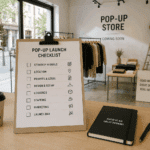
14. Regulatory checklist before booking your pop-up
Before confirming a venue, ask at least the following questions.
The venue
- Is the planned commercial activity compatible with the space?
- Is the venue already open to the public?
- What is its capacity?
- Are there specific restrictions?
Safety
- Are the ERP conditions suitable for the project?
- Will the temporary installation affect circulation or exits?
- Does the concept require additional safety equipment?
Accessibility
- Is the venue suitable for public access?
- Will any temporary works affect accessibility?
Building works
- What modifications are planned?
- Does the owner approve them?
- Is administrative authorisation required?
Façade and signage
- Can you install signage?
- Can windows be covered or modified?
- Are there local municipal rules?
Activity
- Will there be food?
- Alcohol?
- Music?
- Events?
- Audiovisual installations?
- Large numbers of visitors at once?
Outdoor use
- Will the concept use the pavement or public space?
- Is a temporary occupation permit required?
The earlier these questions are answered, the easier it is to find a venue that genuinely fits the project.
15. When should you check licences and permits?
Before final booking and definitely before production begins.
A common mistake is to work in this order:
- find a great venue;
- book it;
- finalise the concept;
- start production;
- check the regulatory constraints.
A safer process is:
- define the activation clearly;
- identify technical and regulatory requirements;
- search for compatible venues;
- verify required authorisations;
- secure the space;
- begin production.
This reduces the risk of having to redesign a façade, remove an activity or change the layout only days before opening.
16. Finding a compliant pop-up space in France
One of the easiest ways to reduce regulatory friction is to start with a venue that already matches the intended use.
A private showroom, a fashion store open to the public, a 200-person launch event and a retail-and-food concept all require different conditions.
Venue comparison should therefore go beyond price and aesthetics.
The operational brief matters just as much.
For an activation in the capital, you can explore pop-up spaces in Paris with Go—PopUp and identify formats that fit your concept.
For more specific projects, Go—PopUp can also support brands through personalised venue scouting and local project execution.
From venue sourcing to full project execution
Regulation is one of the reasons why finding a venue is only part of the job.
Depending on the complexity of the activation, the project may also involve:
- venue scouting;
- concept development;
- space adaptation;
- local suppliers;
- branding;
- staffing;
- logistics;
- POS;
- audiovisual equipment;
- licences and permits;
- installation and dismantling;
- operational management.
Go—PopUp works across this broader temporary-retail process, combining access to spaces with additional project support when required.
For an international brand without a local team in France, this can reduce the need to build a separate supplier network for an activation lasting only a few days or weeks.
Pop-up store regulations in France: key takeaways
Opening a pop-up store in France does not automatically require one specific temporary-retail licence.
However, the project still needs to comply with the rules that apply to the venue and to the activities taking place inside it.
The main areas to review are:
- venue use and compatibility;
- ERP fire and public-safety requirements;
- accessibility;
- building works and modifications;
- signage and façade treatments;
- use of public space;
- food or alcohol sales;
- events and technical installations.
And one principle should guide the whole project:
check first, produce second.
The exact obligations vary according to the activity, venue and municipality, so complex projects should always confirm their requirements with the relevant authority or a qualified professional before opening.
If Paris is part of your next retail or market-entry strategy, you can explore available pop-up spaces in Paris with Go—PopUp and start by identifying a venue that fits your concept, timing and operational requirements.